Wednesday, December 16, 2015

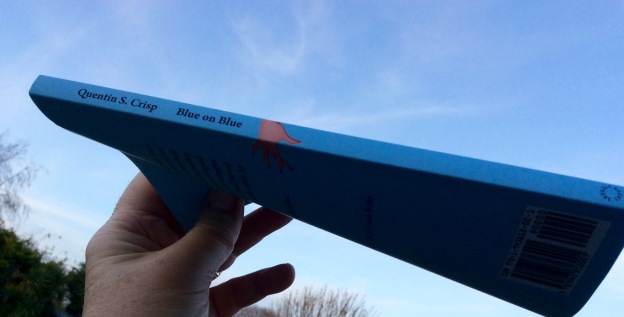
Blue on Blue - Quentin S. Crisp

14 thoughts on “Blue on Blue – Quentin S. Crisp

  1. I. OVERTURE
    Pages 3 – 15
    “…this town, like many others throughout the ASAF, was a centre of wonders, though there have sometimes been complaints that individual aviation now constitutes a traffic that half-obliterates, for the simple pedestrian, the periwinkle sky…”
    I don’t think it is a spoiler to tell you that ASAF (as embellished by the book’s first footnote) is The Alternative States of the American Fifties. The narrator – who couches his, for me, beautifully textured Erithian style in a compellingly page-turning quality – is Victor Winton who lives in Brookdale. A style that describes being between a rock and a hard place of eternity and individualistic modernity, or, on better days, between blue and blue. Reading art books, visiting a museum, castanetting his steps along the pavements, working in a tedious office, writing flyers for Sea Monkey Kingdom, telling us about a slap-happy craze for X Ray Specs… (I had already placed a temporary opaque paper cover upon the outside of this book before reading about the X Ray Specs!)
    I am still feeling my way, but I already have good vibes about this book.
  2. Pages 15 – 27
    “In our lives, does not the resonance of antiquity, as manifest in an ancient statue, meet its equal, at least, in the trivial, immediate resonance of the familiar, as manifest in the cartoon character?”
    As an ‘old’ reader of this book, I can safely say that I have now been mind-boggled by it! There are some very strong colour-synaesthesic and Kabbalistic things going on here. And sexual-gender themes, obsessions and coloured gussets or thongs (my expression, not the book’s), that may infuriate some new-born Facebookers of our world, I guess.
    And the most bizarre interface of ‘analyse’ and ‘anal-eyes’, and a stylistic study of the word ‘between’, that I can only admire. This brought me back to the 1960s when I was taught to do these stylistic studies of words on a daily basis.
    Victor appears to make a study of his passionate interest in comics and cartoon characters, e.g. Snow White v. a Bablyonian statue, individualism v. eternity, and I can only hint at what some of these remarkable passages convey – insofar, anyway, as I understand them myself!
    (A ‘nameless faith’ that SEEMS to approximate my own Nemonymity?)
    “The blue was the principle that transcended principles.”
  3. II. BUENA VISTA
    Pages 28 – 36
    This book takes off in a wonderfully resplendent cinematic lucid-manga, I guess, with Victor’s after office hours spent drawing the comic book heroine, Lara Lovelily (a sort of alternate world Betty Boopty-Boop?) to whom he introduced himself in the previous section of this book, a book that he writes evoking such a cartoon or comic book creation on his part, agonising over the words to describe this activity, no doubt, as he must in turn agonise (WITHIN that agonising) in his styling itself of, say, the image of Lara’s knee with obsession – an obsession once needed by the director of the cinema film Claire’s Knee (my observation, not the book’s).
    All this is coupled with Victor’s lucid environs of Brookdale that surely strengthen in the reader’s mind with the narrator-writer’s own transportation there, a place not only of, inter alia, X Ray Specs but also the invention of that very transportation as copy-original teleporting, in turn strengthening Victor’s theories of copy-original comic book styling, all to the exquisite sensation of his spreading out a crisp new newspaper about all of this on a cafe table!
    That’s me rambling on about something that is much tighter and mind-fantasy meaningful in the book itself, about which book this is my own spontaneous news report spread out in my reading-room mind with its own instilled lucid dream of what is radiating from the book.
    I do not intend to go on at such length as I read on, but who knows! Whatever the case, I know already this is a book that is rather special.
  4. Pages 37 – 52
    “What, in establishing connections and correspondences between the multiplicitous nodes of existence, could make those nodes effloresce unimaginably…”
    Em dashes, here in this book, not en dashes, and no spaces ‘between’.
    Victor’s visit to the museum outside of office hours brings his chicklit encounter with someone called Jenny, and the altered marks around her lips change how she briefly at first seemed like Lara into eventually not seeming like her at all. A sense of truancy, and foreign memory, not my expressions, but the book’s. Whistling as innocence. Recurrent reflections of re-living a conversation as dream-bubble or a form of trampolining…sans serif.
  5. Pages 52 – 59
    “The air itself—void—is easier to describe, though notoriously ineffable,…”
    For any text to agonise—as much as this one appears to agonise upon its own emerging heuristic hesitancy or (to quote this author from elsewhere, yes, from elsewhere) upon the ‘preternaturally secular’—would seem off-putting at least.
    Yet, both his simply ‘seeing’ Jenny Mills (put thus literally in the text, but with the double meaning of ‘seeing’ as ‘going out with’ or, possibly, ‘having sex with’) and his tentative engagement with putting his hand just above her knee (cf my earlier reference to Claire’s Knee) seem to summon such a powerful fascination of projection (hologrammatisation) and subtle plot-advancement, the type of reader attracted to this book actually learns much from—and is entertained by—such obsessive agonising in literary print.
    The guitar and its soundbox, too.
    (The Literature of a Samson Agonising?)
  6. Pages 59 – 74
    “It is a strange thing to feel connected to a person by warmly linked hands, but to feel your two heads are compartmentally separated—yet in their isolation immersed in the same world.”
    There are some truly astonishing passages describing a visit to a Sea Monkey Show by Jenny (a lip-synch short of a connection with Lara who, in turn, has some frame-link with Superman?) and Victor, whereby the audience members are helmeted up to the aquarium itself. Some extended stylistic flair here about sea anemones et al, that is seriously mind-blowing.
    But all this is (deliberately?) offset by some rather wooden speeches by a sea monkey itself who seems to be intent on mouthing a series of statements from Twin Peaks a bit like “the Owls are not what they seem.”
    The mental and physical relationship between Jenny and Victor is one of “transparent sincerity”? This phrase is also how I see the whole book so far… Transparent and transporting. Limpid as well as lucid but, paradoxically, transported by an em-rich text that is not always thus.
    “…an eerie transport in the heart and mind of the watching periphonaut.”
  7. Pages 74 – 86
    “One has to decide either to live with flaws or to hold out for perfection.”
    A möbius non-choice, I suggest. Now Victor (probably given that name by parents who settled for his perfection on day one!) is optimising (settling for flaws but whittling them away one by one in bouts of heuristic artistry?) his professional image of Lara in the plot scenarios that he hopes to sell for cinematic usage, based in some aspects of Sea-Monkery. He almost issues the literary equivalent of a social media vaguebooking post after getting a promising letter about it —– all this in interface with visiting the Buena Vista Castle with Jenny.
    You need to take a breath here as reader, because, from my studied instinct based on long experience, this text takes fantasy into realms where fantasy has not gone before – when establishing the margins between where Victor and Jenny are and where they are about to go, together with the concept of the castle itself from this unique standpoint and of the standpoints of those who built it. And that is where I leave it, all of us straddling this pathway in-media-res, between here (their here not ours) and there on page 86.
    That castle’s “blue room”, notwithstanding.
    “The general public perception is of a benign fog of wonder, promise and hinted wish-come-true.”
  8. Pages 86 – 102
    “People who reflect, struggle all their lives to put things into words.”
    And I am struggling to put into words what I feel about some of these passages, as Victor and Jenny cross the various margins through a distance that kept the Buena Vista castle ever a vista. I could, easily say: Wow! But that seems a cop-out, even if it is justified. For example, I get the feeling this is not predominantly an epiphany towards holding hands and a kiss in a romantic setting (although it is that as well), perhaps not even an ‘optimisation of “crucial loci”‘ (that is called to mind in another coincidentally concurrent real-time review of a book (‘The Siren of Montmartre’) here), but rather its otherwise ungraspable essence is crystallised here in Blue on Blue by, for me, a convincing reference to Dennis Potter’s “blossomest blossom” speech during a now famous TV interview with Melvyn Bragg shortly before Potter passed (I usually say ‘died’, but ‘passed’ seems more appropriate in the context of Blue on Blue.)
    You need to read these passages to get what you happen to get out of them. You may get different things. I was simply left with an impression of the area around a Zoo that is close to my heart where dream is recognised as dream, even it is a dream, rather than, elsewhere, where dream is impossible to differentiate from reality.
    The exact moment when a cinema film becomes iconic rather than a fabrication of cameras and actors?
    Meanwhile, this ‘II. Buena Vista’ section ends with a beautiful, o so poignantly true, word-musical ‘dying fall.’
  9. III. MONTAGE
    “I don’t know who will be reading this, and under what circumstances, or if I shall ever find out who and under what circumstances, but I feel now, before I continue, that I would like to ask the reader a question.”
    Well, unlike this author’s lack of knowledge regarding the Nemonymous reader, I think I know something about the nature of the author, one that colours my view of this book. I feel authors as well as readers should be Nemonymous to isolate the book as an item of study.
    What is the difference between a montage and a palimpsest? I have used the latter word in connection with this author’s previous works. I sense ‘montage’ is more in tune with Victor’s artistic work in comic strips and cartoons when laying one transparent thing over another, and palimpsest more in tune with what seems to be his ‘real-time’ at such creative work layered upon his inscrutable day job in an office. Many of us have this palimpsest if we are creative beings who cannot make a living through such creativity. Still I am procrastinating in rambling in this way. Indeed the author or his narrator Victor seem to be procrastinating with their heuristic artistry as if they are ever on the brink of going off on some errand that will delay the writing of this book or continuing to address us as readers. Each page becoming its own trampoline like a bendy tracing-paper skin…
    This chapter is full of such trampolining empiricism, a transparent sincerity, as he bounces off his relationship with Jenny on buses and her partially lip-synched montage of Lola in comic strip creation, Lara being someone who, Victor tells us, Jenny denies being. Jenny’s elided ‘old’ tells a whole backscript to her own existence in this book as opposed to that of Lara in this book’s second skin of conceptual creation of the comic strip that in turn creates her?
    The montaged layers of blue in rain. The cliche of ‘coming out of the blue’.
    The Dao as non-interference: another form of the habit of vanishing off on errands in case one disrupts, by staying, the set course of events – or in case one inadvertently unpeels, by compulsive toying with them, the natural tracing-paper skins of the living and the dead?
  10. IV. STRIKING IT LUCKY
    “I think we wandered right through from one night’s dream to the next, though I am not sure exactly where the boundary or turnstile might have been.”
    The day job diminishes like a dot on an old TV just switched off? Meanwhile, the teleportation volunteering and Victor’s Lara Lovelily comic strip success entailing his working on a sequel are themselves, for me, another montage, but the need to create the reallest Lara possible entails probably the most incredible passages in this book that you are ever likely to read in any literature, as his studio becomes more of a science lab, with the use of grids for, inter alia, multiple palimpsests of Lara’s own quimmish ‘Origin of the World’, as if Victor is virtually painting-by-numbers alongside the painter Courbet himself when teleported to 1866 (Wikipedia link here but not for those easily offended – and it may also be a spoiler?)
    Function and form, “…you shall be born, but always that you shall be born again.”
    I can now possibly see why I mentioned ‘gusset’ etc. earlier in this review without realising then why I did so. And Betty-Boopty-Boop. Betty Boo or Blue. All a bit ‘squishily personal.’ Each crevice unbridged or scooped free of its troll within or under its uncrossed lips and folds. And tracing-paper skin.
    Any snow, notwithstanding – whether officially vaporised or malignly / haphazardly so. Erased or pointillisted.
    Brainstorming, not rambling.
  11. V. CODA
    In my reviews, I often find myself seeing the last story in an anthology or collection, or the last chapter in a novel or novella, a CODA.
    But, for the first time, the job is done for me here already!
    I note the middle name of Victor Winton is Sernik. Inkers? Cartoonists and diarists et al. We creationists at the Origin of the World are all such, and ink I assume is expressed from their nipples by sea monkeys and other marine life, I guess. To complement or supplement the white as snow milk of ordinary mothers.
    This Coda Is expressly not an obituary but a hindsight view by the editor of Lara Lovelily who’d asked for her sequel. (Jenny?)
    ‘Transposition intervals’ as interferences parked elsewhere to allow a smooth daoism or dadaoism.
    This is a remarkable book where I have only scratched its upper surface. And that’s surely an understatement.
    You need the book’s own X Ray Specs, provided at the beginning almost in passing, to be able to see deeper.
    “Outside is inside now. We have our own land and the branch blossoms outside the window.”
    Potter as pilot. In the wide blue.


Tuesday, December 15, 2015

The Siren of Montmartre – Leopold Nacht


12 thoughts on “The Siren of Montmartre – Leopold Nacht”

  1. About 130 pages, a highly luxurious and stylishly designed book that I estimate to be five inches square.
    My copy numbered 5/85.
    It appears to have seven stories that I intend to comment on as and when I read them.

  2. AN ORDEAL IN THE HOUSE OF ILL REPUTE
    Toyed with by one of feminine knowing, young Emile, in Paris after the Great War (before cruder Assassins polluted it in our own time), jumps in and, later, out of the sash window having played a game with Tarot cards inside, led astray into a musical ‘dying fall.’ I shall follow him, I guess, with my broom, having glimpsed ahead his name in this engagingly knowing prose of place and person.

  3. LES ENFANTS INFERNALES
    “By acts of transgression, by a crossing of boundaries, by the penetration into places forbidden, let us raise the sunken streets of Golgonooza,…”
    Indeed, using the Siren tarot card he picked up in the previous review above as entrance ticket, I follow Emile into an evocatively deadpan template of an initiation into the secrets of some sacred order where a brother and sister submit him to rites you need to see written down here in this book.
    I just wonder if I am a mere observer, one of three Gongoozlers….

  4. THE KABBALIST
    Pages 31 – 40 (first half)
    “We may delude ourselves, but that’s hardly the point. We must give voice to the irrational as an act of conscience. It’s the closest thing we have to prayer.”
    That somehow inspires me, seems to sum up something important in my life of 68 years so far, and I think I shall quote it (attributed to this book) in a prominent position on my website.
    Meanwhile, I am intrigued by my pursuance of Emile in forward time as well as his explicatory backstory with the brother and sister, the reason for the Tarot ‘entrance’ card, and, now, the prestidigitation of switched items, the ‘as above, so below’ aspirations and machinations of this threesome… Speaking in “alternating maxims”… Too much to report on here. You will know what I mean when you read it for yourself.
    Just one item – less obvious and probably unimportant in the still unfolding scheme of this book – the mention of a ‘discreet cafe’ from where watch can be kept discreetly, I assume, rather than the cafe itself being discreet. A truly discreet cafe would never attract paying customers, I suggest. Perhaps, it is just that the character is discreet, making the cafe as discreet as that character, at least for a while. The power of fiction’s leasehold characters autonomously to imbue that very fiction with themselves, even beyond the control of that fiction’s freehold author? Or ‘as above, so below’, again?
    “They rule in secret, unbeknownst even to themselves.”
    Finally, today, I was somehow reminded of a verselet that I myself wrote in the mid-1960s, one that has haunted me ever since (shown at the top of the page here).
    “The myths we build around our obsessions are more real than the mere facts of the matter.”

  5. THE KABBALIST
    Pages 40 – 50 (2nd half)
    “Several of the books featured no title at all upon the spine.”
    Our initiates are noble intruders to a room where you won’t believe the quietly transgressive art and books they lovingly rifle (including, it seems, this very book, one that only has initials on its spine, I notice). The belongings of an occultist or a pervert? There is something special going on here. Only reading the immaculate and tantalising text will help you towards understanding what I mean.
    I slipped in with the groceries woman, too, and slipped out, without the text even noticing.

  6. THE GATE OF ETHER
    Pages 52 – 62
    “‘The pages are crammed with handwritten segments divided by elegant fluer-di-lis,’ she said, as she created tiny whirlpools in her coffee with a long, thin stirring spoon.”
    This is fluently SICnificant, I guess, as the three of them compare notes. But the rest of this first half of ‘The Gate of Ether’ reaches the point of Emile’s entry into that gate (with which event I will tantalise myself by means of a delay before reading it the next time I pick up this book) – all this following Emile’s retreat to his bedroom, his dwelling on his family backstory, his reading a truncated page about drowning in oceanic knowledge amid the Siren’s call, and our learning of his methods of astral etherisation with the Mansion card.
    The prose still teems with dark sumptuousness.

  7. THE GATE OF ETHER
    Pages 63 – 69
    “By strength of will, he attempted to shift the point of view within the image such that he might be enabled to peer beyond the threshold of the open door.”
    Indeed, I have that control over my own point of view as a reader, bending round the words to espy, for example, the two versions of the Kabbalist – both of them being within Emile’s vision of visiting the mansion of his dream, a vision sometimes like a cross between a computer game and a vista of a house FROM this side of the CS Lewis wardrobe not INTO it, although those analogies of mine demean the actual vision that is couched here so well – a Kabbalist who, with his bearded face, looks a bit like me? There is much else in this vision that will haunt you, for example Emile seeing an image of two children who look like younger versions of the brother and sister…

  8. SERAFINA
    Pages 71 – 83
    “…the extravagant angels of the avant garde.”
    A wonderful description of Montmartre that, for me, feels like a version of Area X with its own Kabbalistic heart, followed by haunting machinations concerning a new tarot card (the Lighthouse) and the prospect of Emile’s visiting an earlier character, the prostitute – which he does – and possibly meeting the woman in her painting…
    I should not itemise the exact plot for you, but just these my own adumbrations as limned for my readership of a text by its exquisite aura, one that makes you feel that more is hidden than revealed. Just like in this review of it?
    The optimisation of ‘crucial loci’.
    “One orients, the other disorients.”

  9. Pages 83 – 98
    “She smelled of sapphire, ambergris, extravagance.”
    This is surely a reading experience not be missed, the second half of Serafina, pages read, for initial gratuitous reasons, during this evening, instead of tomorrow morning, while synchronously listening to dark and deep music by Sofia Gubaidulina, interspersed with JS Bach and Arvo Part, being broadcast as a live performance from Dundee on BBC Radio 3 at this very time of reading it and writing about it. A perfect match, a magical transformation to the accompanying prestidigitation of devilish cigarettes and mirrors, of recurrently sensuous inhale and released exhale to another perfect match of words, to the revealed backdrop of the book’s recent backstory of Montmartre’s Wartime occupation, towards the appearance of the woman herself, whence she who first invited Emile to meet her, she who came only when the other woman was not. An experience of reading and seemingly seeing what I am reading, plus a chance real-time listening within the room where I sit alone with this book. A further optimisation of crucial loci? Or as this text has just explicitly said…
    “I’m pulled along by influences that don’t seem to be under my control.”

  10. THE GATE OF OBLIVION
    “The world had come together to compose for him a symphony as intricate as it was perplexing,…”
    This is powerful stuff, and perhaps made even more powerful by my again serendipitously switching on BBC Radio 3 this afternoon as I read this section and being suffused with the sounds of Ruud Langgaard’s ‘Music of the Spheres’ that happened to be on their playing schedule, another perfect match for the words. I somehow feel myself blessed. Yet, blessings are often mixed, and I felt both suffused and subsumed, no doubt the text’s intention, as Emile, following the abandonment of the Order by the brother and sister, dares to place his own self in a form of abandonment to the silken ties, tethers, loops, and inferred knots or ligotti – and, by his infused vein, transporting this self, as it were, into the ruined balconies and other derelictions of the once occupied city and then into his own transvestal transfiguration as beckoned by the Siren’s call, a Siren Risen…
    There are many such rhapsodically syntactical meanings in the text. You will be overcome either by its florid extravagance or by its perfect epiphany, depending on your own temperament.

  11. THE LABYRINTH OF LUSTRAL WATERS
    Ruins are a sort of stone made fluid, I sense, and Emile is borne upon it from the previous flow, just like one more orphan of war sinking like Elizabeth Bowen’s dead shoals of the blitzed dead, drowning with and sinking through all the famous artists of Montmartre. Emile ends up as a sort of sewer residue – faced by another character who I sense is blended, too, from the wasted human residue, perhaps making all of us characters, too, part of an undifferentiable ruin-sown morass, scatological as well as eschatological?
    Or this is Emile in the real undifferentiable, mysteriously and confusingly light-sourced and unbound bowels of a still living city that is slowly absorbing the occupied as well as the occupiers. Each street labelled below in this catacomb of catacombs whereto each street’s effluence flows.
    A mighty vision that is quite stunning, blending Blake with Baudelaire, the only
    anthem to be sung in such depths being one towards, I feel, where the axis mundi, the once Mount of Mars, has become a dead monument to once ancient hope. Ruination in bloom.
    This section of the book read and reviewed while listening, by chance, to Elgar’s Enigma Variations, particularly the anthemic Nimrod.
    This physical book’s sumptuous design and artwork is also a perfect match.
    “There’s a price to pay for the attainment of forbidden knowledge, and I’ve paid with interest. I can assure you that it’s well worth it.”
    Part of me is still sweeping leaves with a broom, though, back on page 19.
    end


Thursday, December 10, 2015

Jottings From A Far Away Place


15 thoughts on “Jottings From A Far Away Place”

  1. imageOBSERVATIONS
    “It was like a man throwing away pearls, so as not to be robbed.”
    Just as if the author of this book is jotting here in four numbered movements some wildly amazing and original conceits so that nobody can rob him of them first!
    The third movement is an oriental theme and variations on Hank Williams, this and the rest still percolating in my mind.
    Oriental, I Ching, Dadaoist…Apollinaire? Ezra Pound? Ferlinghetti?

  2. HABITUALLY DANCING
    Eleven numbered movements. About someone called ELON — LONE (as the Christian Name of someone called RANGER) or someone mucho called LEON? — or plainly ELON, the Biblical Judge from Israel? This is sumptuously and horrifically Eucharistic prose.
    [My reference below plus an invitation to seek out its full context, not this book’s reference: From Hank Williams: “Deck of Cards” – “I think of the Blessed Virgin Mary…”]

  3. SHOWING THE WORLD
    Here, within the numbered movements, there is a long one depicting a sort of fable or fairy story about a Prince-elector getting a Castle Builder to build a splendid Castle, but when he looks through the window of his new Castle, what does he see? This story feels like an archetypal tale that has sat within my head for years and when I look out from my head, what do I see?
    I loved it.
    This now brings me back to my interpretation of the pearls in the first section of my review above.
    There is perhaps something building up here, a gestalt, an archetype, a migrancy of themes across Schengen borders, all waiting to be drowned in the intervening Jungian seas, and I am only beginning to feel something working, perhaps even beyond the control of the author himself.

  4. ENTRUSTING
    A RAMSHACKLE VILLAGE
    GHOST CAVE
    “Words aren’t precious, but nothing is.”
    Three sections, each with their numbered movements. I originally used the word ‘movement’ because I initially saw these as musical symphonies. But now I see them more as a scrying devices like I Ching but disguised as fables or proverbs used by beings visiting our planet and still learning our words, striving to extract hidden stories already ours, so as to fool us or to entertain us with a deadpan tantalisation just beyond our grasp – tutoring us piecemeal to become more like whoever these storytellers happen to be.
    The next, as yet unread, section is entitled ‘Gradual Activity’ beginning, I glimpse, with: “People love to be distracted.”

  5. GRADUAL ACTIVITY
    UNCOMMON
    Uncommon seems to be a word contrary to the Schengen or the Jungian, creating uncommonland across several borders with a new antistate (ironically like the male prostate!) disguised as a unified state where some of the searing brutality is expressed by Connell’s sinuously resonant language, with its aesthetic, yet cruel, edges of phonetics, semantics and graphology, massed then into sharply forged syntax.
    It is as if an Old Testament State has here replaced the so-called Islamic one or vice versa, then a Judaic one or Gnostic. Vying with each other, then even becoming each other in uncommon fashion.
    ESHAI
    I AM WHO I AM
    SARIEL
    ORNAN
    BRENDAN
    ET AL

  6. DEFILEMENTS
    GESTURE OF BOWING
    MANY-COLORED EYEBROWS
    ENTITIES
    These further politically incorrect, fulsomely adumbrated sections presented some hilariously bawdy Catholic concupiscence, plus the concept of crushing some sort of slithy tove with a dictionary making me think that, with the Internet and other ebookery, we are increasingly unable to wield books as heavy weaponry against things that crawl out of those very books!
    In this book, most of the words themselves seem to suppurate before applying their meanings to the already busy text.

  7. MALADJUSTMENT
    NOTHING TO HIDE
    SLOW AMULETS
    “‘What is the project at hand?’ he wondered.”
    From a Picnic at Hanging Rock scenario with historical outcomes towards a thread I denote of words as foodstuffs around a central character as an impossible literary project who has not yet fully appeared. One just needs to ride the elisions, elusions, delusions, allusions, illusions, of a Lawrence Durrell writing a Finnegans Wake through the medium of a John Barth.

  8. IRREVERSIBILITY
    “…a bit better than Voltaire and, in my estimation, equal to Diderot.”
    Diderot, in my estimation, is more equal than most.
    My real-time reviews of two of his works HERE and HERE.
    Meanwhile, the no. 4 jotting of this section is an engaging portrait of meeting an old friend and, later, this friend’s wife, with startling results.
    Full of maximal maxims for life. With cocktail words as small talk to match.
    (As an aside, earlier today, I had significant business dealings with a firm called Connells. I had been reading this book while waiting to meet them. Talk about synchronicity! But, even stranger, it was only just a few minutes ago that I suddenly realised this coincidental fact.)

  9. EMERGING FROM A TRANCE
    Two longer pieces among this section’s psalms (perhaps a better word for the numbered subsections than musical movements or I Ching psammomancies or, even, jottings) – the first one feral and transformative, just like the language expressing it (it is too easy to take this for granted, i.e. Connell’s trademark strength of style), the second one seemingly Rhys-Hughesian or archetypical, about being reincarnated as a spoon.


  10. CONSTANT PRINCIPLE
    HOLDING UP THE SKY
    RED DALMATICS
    BEWILDERMENT
    SACRED CONTOURS
    GIGGLING FLUTES
    WORN-OUT STRAW SANDALS
    GENERATING WORLDS
    I have read the rest of the book in one sitting as if in a single osmotic orgasm of words, this being my attempt at automatic reading like a reversed version of Andre Breton’s automatic writing. And it works, I feel. Think Salman Rushdie (a long-term favourite writer of mine) and his latest novel that I recently reviewed HERE.
    I wrote there:
    “Sometimes with fiction the reader needs to remain passive and not worry about actively seeking messages from the unfolding events, a sensibility which is part of the usual nature of my dreamcatching of books, I hope. This book needs an even more passive, non-preemptive approach, allowing the messages, after finishing the reading of the work, to create their own tapestry, before you even stand back to look at any gestalt.”
    That applies to this Connell book, but even more so! I mean that as a compliment.
    This is probably the most experimental book I have ever read. [And I am someone who has read (and reviewed HERE) FINNEGANS WAKE!]
    A psalmistry supreme. Sentences that are whole mind-culinary recipes. A Jackson Pollock picture of words, painted by numbers.


  11. “There was a man who painted a very beautiful picture.
    ‘That is awful,’ said his friend.”