Monday, August 27, 2018

6 Shorts 2013

6 Shorts 2013


8839240B-0476-43C1-9BC2-075CBF5FC6ED
Miss Lora by Junot Díaz The Gun by Mark Haddon Evie by Sarah Hall The Dig by Cynan Jones Call It ‘The Bug’ Because I Have No Time to Think of a Better Title by Toby Litt The Beholder by Ali Smith
The Finalists For the 2013 Sunday Times EFG Short Story Award
When I read this book, my thoughts will appear in the comment stream below…

8 thoughts on “6 Shorts 2013

  1. Miss Lora by Junot Díaz
    “Almost every night you had nightmares that made the ones the president was having in Dreamscape look like pussyplay.”
    “Let it roll around in the channels of your mind. This is nuts, you say to yourself.”
    It sent me duly nuts, this Spanglish romp, written pre-Trump era, but somehow post-Trump. A 16 year old boy, with poignant backstory, regularly screwing older eponymous woman, scrawny with no titties. Deepens with each future reading, but I have read it only once so far. Asses and fucks galore with words that stutter in paragraphs and flow like there’s sense in them when strung together; it’s as if he’s screwing into the back of nothing. And they both closed their eyes when doing it I guess. One of them from shock at what is being screwed however addictive it is, the other from guilt, maybe. A rite of passage.
  2. The Gun by Mark Haddon
    “Except there’s no wind this morning, just an unremitting mugginess that makes you want to open a window until you remember that you’re outside. Mid-August.”
    Mid-August now. How many more mid-Augusts left? All different. Some alternatives to other even more different ones. This is a telling story of bifurcation and absurdity of events, often listed simply as deadpan descriptions, like a cow falling through a ceiling, chance choices made, haunting visions seen, a vision like a man in a car watching you cross the dual carriageway with an overstuffed derelict pram. All part of one life, bifurcated several times, till you don’t know fully who you are. Your special needs sister with the light gone, never to avoid a boring, soulless life. Cf the deer’s life (“That desperate hunger for more time, more light.”)
    A story of a boyhood friend absconding with his dad’s gun and takes you, Daniel, as another boy, with him in forays of naive shooting and facing out a bully called Robert… many memories that hang about in under-scored passages of striking text you want to remember. Too many to quote. Too many to make a single you. Life is surely not that rich, unless bifurcation is not bifurcation alone but also recurrence? Not all recurrences are ‘boring’. That desperate hunger for more time, more light. Again and again.
    “A military plane banks overhead. Daniel is both disappointed and relieved that he is not offered the second shot.”
  3. Evie by Sarah Hall
    “It’s inside the daylight. Making each other wet. It’s all the way in. In.”
    Three students, two men, one woman, their backstory, one of the men and the woman marry, a gradual accretion of sexual desire in the woman in later years with her husband, at first with the aid of pornography, then with the other man as a third participant. A contextually disguised story from the Pan Book of Horror, where the sexual urge becomes an insane monster as well as a physical disease. Powerful and gratuitous. No way you would want to meet this monster in a dark alley nor in book where you don’t expect it. But once having met it, you have mixed feelings about enjoying it as a literary work or even about becoming a monster yourself. The ultimate spoiler.
  4. The Dig by Cynan Jones
    “The way was to have a minute hesitation before doing things. This came from trying to be eager and cautious at the same time around his father.”
    “They had to couple the right dogs. Dogs that could work together at rat could fight at a badger dig, as if they sensed the individuality of the process.”
    “But the big gypsy seemed to be rapt, a pasty violence setting in his eyes as he listened and watched Messie, his bitch, solidify, focus. Finally, the dog let out a low whimper of desire.”
    Almost an echo of the human urges in the previous Evie story but here more animal, somehow more honourable amid gypsies and countryfolk with less base but more basic instincts, but here there is more to fight for, less selfish, more harum scarum yet with formal pecking orders of hunters and prey, to link into a rough-shod Gaia. A running or digging to earth with adept choice of bitch and dog against rat, badger, boar and mink, mink as a sort of consolation prize. A gawky boy, bullied at school, his first such dig, a sort of coming of age with his pup. Lived this through him. And I felt scored over and run to ground myself by the pithy prickly paragraphs. Beyond sex.
  5. Call It ‘The Bug’ Because I Have No Time to Think of a Better Title by Toby Litt
    We enter the world of the Cynan Dig again and the Evie or Lora Orgiastics, but I, for one, sit lurking at the threshold bugearth of this text ready to pounce on digging out my own cure-all bio-punk bug that it generates in moto perpetuo, waiting for this bug to emerge without ‘vultures’ disguised as you other readers getting to it first –
    “For bug installation, no surgery is necessary – the new host simply swallows the bug, which is about the size of my mother’s little fingertip and which disassembles in the stomach; for uninstallation, no surgery is necessary – when the bug detects that brain activity has (legitimately) ceased in its host, it reassembles in the liver and makes its way down through their lower intestine, using needle-like pinions, quickly emerging from the rectum. At this point, the bug is ready to assimilate itself to the first health-host that comes along and swallows it.”
    Sorry for the long quote, but I need to stake my claim as I weave within this Litt-provided Choose Your Own Path to Adventure (a method of ‘fiction’ from its heyday during my own son’s boyhood). Combined with geomancy like, say, geo-Goa, reaping the chance event or the prescribed event like the dying of one’s own parent to guide your path when you visit the hospice, but, meanwhile, who stalks whom – or vultures whom – in the bug stakes? To be or not to be, this consuming Litt-fiction somehow makes the reader feel more real and in control. Or is it just me? Using this reviewing technique as an interface?
    “Fictional characters, even underdeveloped ones, should be accorded their human dignity.”
  6. The Beholder by Ali Smith
    “I wonder what we’d call padlocks if we didn’t call them padlocks.”
    “On days that are still I can trace, if I want, exactly where I’ve been just by doubling back on myself and following the trail I’ve left.”
    Cf THE GUN and its ever-bifurcated trails of fate. Here, also, a near-absurdist,
    Proustian rhapsody, an autobiographical rapture of delirium and clear sight – and things coming out of the body as in the orgiastic sex or dog /bug hunting in the other stories. Here, it is a doctor-defeating body-growth (a green half-crown becoming a sharp plant with briars) in an averagely frustrating life of a protagonist. One where sleep is a hospital ward or a feel for a healing word like ‘sleep’ itself, nay, many words as words that are beautiful objects to curl within , even a word like ‘wank’ willed to be beautiful. And the song of a mongoose…
    The experience of this sexy or sick six is unique, I’d suggest.


    Sunday, August 19, 2018

    The Secretariat of Tenebrous Anatomies – Karim Ghahwagi & Bethany White

    9 thoughts on “The Secretariat of Tenebrous Anatomies – Karim Ghahwagi & Bethany White

    1. 0BE09039-C6E7-47D4-A9B9-53A623AA4680
      Left is an extract from Bethany White’s “Board”.
      There are also two stylish-looking booklets written by Karim Ghahwagi.
      All above a unit (seemingly with a black compass); mine are numbered 3/40.
      The novella has over 30 pages.
      The rulebook over 90 pages.
      245A339A-B2CC-42A4-8A7E-0D77738D6214
      DF1DF2FC-42C8-4283-85A1-5927559738C8
    2. “Because the game, as a prayer, allows each of us a repetition of certain points of the nature of God through formulas that, once memorized, can be repeated in silence, in the confines of our mind, of our dreams.”
      — Alcebiades Diniz Miguel
      Through one mask to another mask?
      THE SECRETARIAT OF TENEBROUS ANATOMIES
      Novella by Karim Ghahwagi
      Pages 1 – 5
      “Envisioned as part role-playing game and part boardgame,…”
      The game’s inventor (he tells us here of this invention) also works in a sort of Ligottian company and is asked to replace his recently dismissed supervisor, i.e. to be the supervisor himself, and he seeks to consult this supervisor outside the company to help supervise his own way forward in the circumstances of that role. I will not tell you more than you need to know before reading this work. To describe the nature of the game, beyond the above quote of surface envisioning, is beyond my own role. Unless the author tells me where I am going wrong? No, because by dint of the long-seasoned literary theory of the Intentional Fallacy, when you have written some fiction or poetry and after it has been published, you are no longer its author but just another reader … but still someone worth consulting if only in that role as another reader. A triangulation (or secretariat?) of readerly coordinates. The more readers the better, especially when dealing with any tenebrous anatomies.
    3. “I have now read ‘Metaphysica Morum’, but not yet read ‘The Small People’. I don’t think it’s any accident that Olan is an anagram of Loan, a loan being a two way ‘deal’, infecting and benefiting both ways, just as ‘demoralise’ is, in its modern sense, to make someone lose hope but, in its archaic sense, to strip someone of morals.”
      From my 2014 review here: https://dflewisreviews.wordpress.com/2014/07/21/the-spectral-link-by-thomas-ligotti/
      Ghahwagi’s novella…
      Pages 7 – 10
      That supervisor the narrator has superseded is called Sloan, note ‘loan’.
      And the firm’s business with which he and Sloan were involved: AFTERLIFE INSURANCE™.
      I am grabbed by this material, but I am determined to slowly savour it.
    4. Pages 10 – 16
      “…even greater challenges and puzzles. This pattern in my own thinking, I had come to define as the Conundrum Complex.”
      I rôled a dice, myself, and it told me not to divulge the secrets of this book, but I can say that it’s a mixture of a game, a detective story and a method to join with your dead ones via séances and places called Cenotaphs. The fact that the narrator bends the truth – when dealing with one whom he befriends during his path of investigation – makes me think there are rules that can be bent in the game of this gestalt real-time review that somehow supersedes the game in the plot. Or, horror, vice versa? (Notwithstanding the make up of the secretariat of you other readers?)
    5. Pages 16 – 22
      “Eighteen months at the company, and I had never ventured above the fifth floor of the building.”
      Essential Corporate Horror fiction or an ultra-real post-Ecrisis rôle-playing boardgame? Probably both.
      “Now, a company is like a living, breathing entity, and every single one of you gathered here this afternoon, form an integral part of that body.”
    6. Pages 22 – 26
      “He encouraged me to go see the other Mr. Minion two floors higher up.”
      It seems synchronous that today recriminatory levels of security clearance are reported in the American newspapers, well, in all our newspapers. Keynotes – and telling, too, in this work, that men named Minion are at higher levels… reports of Sloan’s “spiritual malaise”, and the codes and game points etc. we need to garner as readers or participants. Some beautifully worded passages in these sections, as if tapped into some reality of which even the freehold writer is unaware?
    7. Pages 26 – 31
      Thus the first luxurious booklet furls its novella – the narrator’s relationship with a deepening or, rather, heightening knowledge of the corporate building and the closing game rules of “difficult ground” and “destroyed ghosts”, and I am constructively reminded of the ambiance of my latest favourite fiction work, THE UNCONSOLED by Kazuo Ishiguro. The Ghahwagi novella’s own context within its own gestalt of parts has yet to be fully examined – and I keep my powder dry.
    8. “The Lost City is filled with many dangers…”
      AFTERLIFE: THE RULEBOOK
      I am not an expert on rôle-playing games. The last one I payed was Dungeons and Dragons in the late 1970s.
      This is a 90 page rulebook for a real or imaginary game; I leave you to decide which.
      It seems to have Ghahwagi’s darkly evocative flair evident in the novella.
      The astonishing Board by Bethany White is about 12 by 16 inches as a guesstimate, a slightly gritty brown and flexible parchment with black and red inking upon it. You can pore over it and gain Escherine and other depths and dimensions. It needs to be seen first and foremost in the curling flesh, as it were.
      I will leave you there, as I would not be a guide more dependable than yourself. Suffice to say, I am very intrigued and will hopefully be able to seek the opinion of my friends more suited to an assessment of this game, whether real or imaginary.
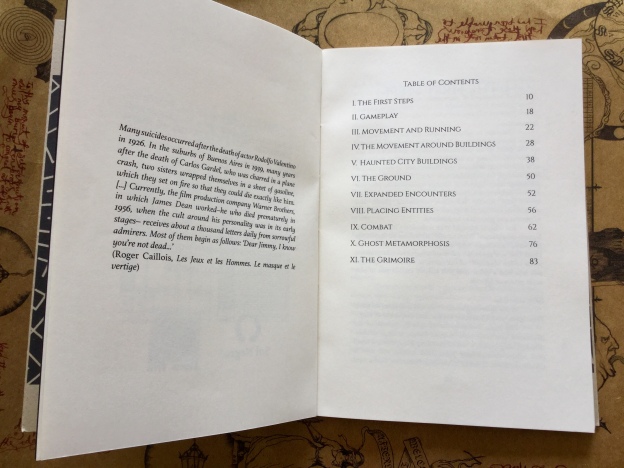
      The contents page…
      DBBD4F65-5C52-493F-A6DC-D91E114FF0D8


    Friday, August 17, 2018

    Figurehead by Carly Holmes (part 2)

    Carly Holmes

    figure
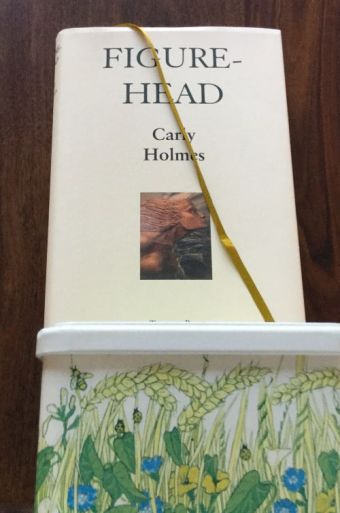
    FIGUREHEAD by Carly Holmes
    Tartarus Press 2018
    Continuation of my gestalt real-time review from HERE.
    My further thoughts will appear in the comment stream below…

    18 responses to “Carly Holmes

    1. THREE FOR A GIRL
      Pages 121 – 146 (2nd half of novelette)
      Possible spoilers –
      “, and the bell was dented where it had been thrown against the wall.”
      The end revelation is to be dwelt on before coming to a conclusive assessment about it. Meanwhile, this work borders on melodrama and contrivance, but is this more from the attic above it all where a Mrs Rochester squats with the cheese crust on top of organic things below? No, more instinctively, the work’s clinching adeptness of feeling and objective-correlative is probably beyond melodrama or contrivance as I gathered by becoming gradually entrammelled by Marie’s disarming narration, where two sisters compare themselves bodily from childhood onward, bony hips or more fulsome spread of femininity, linkage with their own childhood into today’s visions (frighteningly real visions or imaginary-mad ones?) via children in trees or among the mansion’s maze, factored into the respective states of one sister’s pregnancy with a bodily fulsomeness where there was once a greater boniness and of the other sister’s recently gutted pregnancy now offered a re-stocking by one of the past’s cruelly treated souls who once reached unwanted full-term as a small human. A large mansion’s inner doors opened or shut to let others out, or keep them back in. There seems something intrinsically meaningful there, but ungraspable. Shattered eggs within the mansion. A poignancy of sound in crushing bones. The poignant moulding of belly’s dome as part of that earlier jigsaw. A story that counted magpies, “as I slapped slices of cheese between bread…”
      [It has occurred to me that Colin Insole is a writer recommendable to anyone who enjoys Carly Holmes’ work.]
    2. STRUMPET
      “Iris purple and stem green.”
      Strumpet sounds like something from Shakespeare; each one is cut from the same family cloth, woman born to woman, no specific man described, yet done up to attract men. Painted tarts, from childhood to older, flighty and flirty borne by textured prose, figure-headed, yet only two pages to count…one or two might eventually come back petulantly with a Maria’s Silence as naked truth?
    3. RUNTY
      “I carried a bottle of red wine and a tumbler into the garden as dust thickened the edges of our street. I dribbled a little onto the ground as homage to the gods of the earth and drank the rest greedily.”
      A symbol of our times.
      This is a well-observed, neo-Bowenesque portrait of arguably justifiable paranoia and eventual self-consciousness experienced by a woman narrator bird-feeding in her garden and chatting with the eponymous jackdaw, imperviously watched by the man — as passing-guest in the tourist house next door — in his behavioural manner of a mutant form of the Maria’s Silence syndrome. The ending reminded me obliquely of GHOST STORY.
      Another 24 hour period of my being similarly haunted by another pervasive Carly Holmes work of the day!
    4. INTO THE WOODS
      “She goes into the woods to read poetry”
      Three pages of something that is visually like a poem as enjambmented by, say, DH Lawrence, when he was a poet, with some stanzas starting with the incantatory refrain “She goes into the woods…”. Honestly Holmesque, I’d say, with everything I now find myself loving about this author’s work. The lycanthropic shimmer at the end, included. Tactile, fey, faerie and intravenously Gaia.
    5. ALTER
      “Forcing oneself to behave in a way that can only ever circle in on itself, counter-productively. Animals would never indulge in those compulsions, they haven’t the luxury.”
      I am like the quilt-jacketed old man in this story? Spotting the fruit of her dressing-gown décolletage? Nope, I am a literary critic spotting there is today more than just a shimmer ot lycanthropy or, at least, a feral quality in this powerful, still fey, but less faerie, story of a man whose wife’s body clock does not match his workaday one, her own own bodily and mental décolletage trending in that feral direction, a marriage in decline, encouraging badgers, and the state of the world beyond just sitting at the altar of the rolling news.
    6. BEFORE THE FAIRYTALE
      “The rest can be history.”
      A story of two pages, a sister to the previous story, here more a flicker than a shimmer, dug to or from a fox earth … earth her own intravenous Gaia? Vermin or vixen? Royal scion or scab or scarifier?
    7. BAKE DAY
      “A person: she became a person.”
      Twice-cooked. Short of the permanent measures taken in SLEEP, this is a serious self-therapy method for mothers of young children to become their own women at least for a while, childless and frivolous, with the collusion of the children to become digestive. Biscuits galore and undercurrents of gingerbread houses and fey faery. Jollity and stoicism. Important fable. Even more important within the gestalt so far of this book. A story of one’s bodily foundlings unfound.
    8. Another impressed carpet: https://nemonymousnight.wordpress.com/the-carpet/
      FRIDAY
      “Bake, and bake, and bake.”
      Now thrice cooked, not twice. A poignant portrait of Penny and her dog, Penny, whose carpet holds the impress of her history, in her house, near the literally encroaching hills. I mentioned intravenous Gaia earlier, for now some unknown reason, and here is its obliquely negative human-instigated embodiment, as a significant Friday also encroaches as fast or slow as the “jostling” hills do encroach. The slumped curves she left in furniture, bulges of her feet, and we gradually gather, by her phone calls, and italicised thoughts, what Friday brings. Awaiting either clinching encroachment or a crucial breaking out. Rubbish on street verges verging. Sticky pavements, too. Shadows deformed. But no surrender to sleep. Yet. Or a putting to a different sleep (one this book has already encroached upon), the clinching sleep of someone Penny loved, already sleeping?
    9. HEARTWOOD
      An original, evocatively tactile tale of a mother who is a were-tree, her children, the brother and sister, in two minds about this blessing or predicament.
      Intravenous Gaia now in overdrive!?
      Slightly connected…
      My favourite passage from one of my long-term favourite books: MARTIN PIPPIN IN THE APPLE ORCHARD by Eleanor Farjeon:
      http://www.ligotti.net/showpost.php?p=8900&postcount=1
    10. FIGUREHEAD
      “…strapped into a hoist, heaved into position, I gazed upon the sea for the first time…”
      …as I once did upon the wordsea of literature. This book’s flagship story is the pungently punctuated, innuendo-riddled narration of a flighty, feisty figurehead once carved from the mother heartwood of the previous story, on her last voyage, with her Sapphic yearnings for a younger figurehead on another ship – deploying, for me, the essence of ‘hawling’ as mind over matter, imagination over mind, straining, by dint of preternatural will power, her own ship’s sinews towards what may be a kamikaze kiss. Adorable.
    11. THEY TELL ME
      TEETH YELL?…
      Yellow Wall Paper syndrome replaces ME?
      This is an ultra-powerful narration by a woman, a broken version of the feisty Figurehead, this painful and stylish screed breaking her own version of Maria’s Silence, her teeth, she’s told, holding her madness, now being gradually extracted and later the innards that set her back into the wallpaper, I guess. Effectively imprisoned by her husband and doctors in this lunatic asylum for women where she seeks female companionship against the onset of the world that put them there. Horrific and hopefully cathartic. A major work within a major gestalt, never to be extracted.
    12. WOODSIDE CLOSE
      “, passing coded messages from yellow gaze to yellow gaze.”
      A tale of significantly accretive heartwood’s onset of reclamation of the numbered houses in the Close, with creative tension between those who welcome this onset and those who try to escape it. Some of us even welcome back foundlings of childhood fairy story lore – from our own heartwood’s past. One of whom gnaws on a biscuit… I sense that those who “set their faces to the dark heart of the wood” opened this book first.
    13. I reviewed the next story here: https://dflewisreviews.wordpress.com/2017/11/17/black-static-61/#comment-11091 and below is what I wrote about it in that context…
      =================================
      A SMALL LIFE
      “Fish nuzzled the water’s surface from below, ghostly shapes in speckled bronze and silver floating up through the murk.”
      Were they Tench? And meanings float up, too, through the river of this powerful story, through its riparian renewability, always a new river to touch the next time you touch it. Written in a linear literary style with the feel of the balanced stars of Lawrence, a style that I often admire, evolving, though, into a non-linearity, whether it be of this review’s earlier assumption of man harassing woman or now vice versa? It’s you, not me. Daring to face the curse of Humphrey’s Google temptation. Pearls for teeth. Men pretending to be dogs. Meanwhile, this particular story starts with a striking description of seeing the land differently from a boat. And of the seemingly healthy gestalt of a boatful of men in coxed and coaxed unison. The aspirational gestalt of all the books I continue to review, as separate from their authors. The ghostalt then created by an impingement of a single woman, with all that event’s sexual implications. The male narrator’s fight with alcohol while trying, forgive the cliché, to find himself, together with the act of minding his own business, with slippage back and forth. Then the, for me frightening, human-shaped landscape glitch or monster as symbol or something pretending to be thus, as if imputed to be born from the author herself? The at-arm’s-length of the literary intentional-fallacy made closer and closer to self? A mighty work.
    14. BENEATH THE SKIN
      This is your sacrifice to save your community, feeding him just enough of yourself, “the startled shift of small life”, a bodily re-wilded nightmare of freely given residues of flesh and blood as meat to the jaws of some prehensile precedent of geopolitical evil (I infer) or even of a predatory reader reading what is still written here … a meaty tunnel to thrust into …a recurrent altruistic spell of fiction to keep today’s claws sheathed at least for a while before they sink into the words again? This book is never one to be read lightly. Even when its end is in sight. Because you know it will make you read it again.
      “This is your moment of power and he lets you indulge it. He knows you won’t turn and leave him. You never have.”
      • ROOTLESS
        “They wanted this one so much.”
        A coda to this book denoting its overarching spirit’s Proustian selves from youth to age, doubled as a required aching coda to THEY TELL ME, just to look forward to there being no ache at all. A bridge or arch or fey faery cap. A Tooth Fairy as catalyst, or whatever oversees this book disguised as one. Ache becomes agony, each versioned self a catharsis for the others. Hooded in heartwood. Too many biscuits. Never has there been, I suggest, such a Dentist story. One that finishes this book with a promise of returning to milk the ones earlier, a book that has a mighty blend of Elizabeth Bowen, Angela Carter, Caitlín R. Kiernan, Clarice Lispector, Colin Insole, Melanie Tem, Silvina Ocampo, but essentialy unique, Holmesque, and, as I saw someone recently echo my ‘ultra-powerful’ word about this book, I sense it indeed has that sort of transcendent power, a power that now fully starts working even as I write these final words about it.
        End

    Wednesday, August 15, 2018

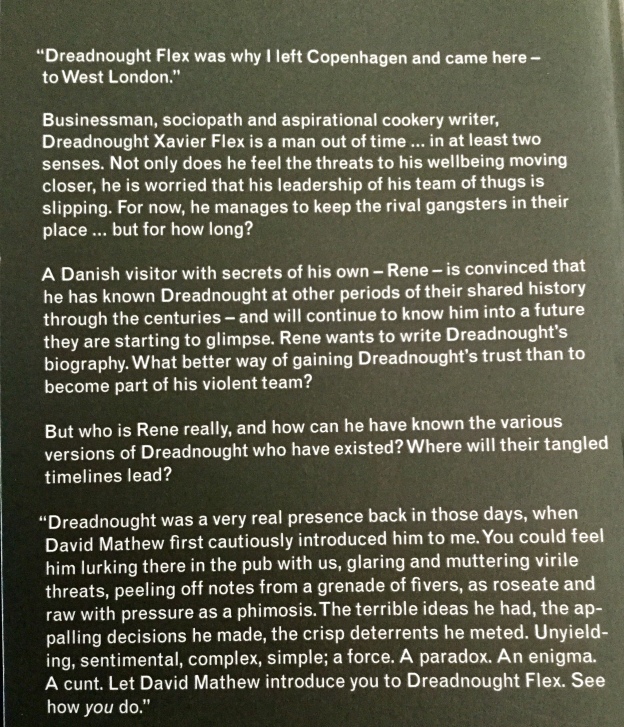
    Dreadnought Flex by David Mathew


    20 thoughts on “DreadnOught FleX – DaVid Mathew”


    1. BOOK ONE
      Pressure Points

      I. CRISIS WORK
      “Wish me luck.”
      I’ll need it, but I lap up entering a Mathew world again, with one tantaliser about Bible Street Cars, and more pub names to drink myself to Hell for. I love genealogy as the first crumb in this gingerbread trail, Rene Haabjoern as narrator (cf René (re-born) also as destiny-spinning narrator in Salman Rushdie’s latest, Golden House, a style not completely dissimilar to Mathew’s; I finished reviewing it in the last week or so, and that comparison giving BOTH authors a huge compliment) — and the preternatural audit trail (cf audit trails in Gestalt Real-Time Reviewing generally) to West London to seek the eponymous ‘hero’, the latter’s efficiently just-in-time fixer-ruthlessness in tracking down, too, to Heathrow, finger cigar-cutting in departure Lounge, fingers later turning up in pork scratchings, and giving or receiving advice about finding a Persian Rug (answer: in a carpet shop!). And on this veering timeline, these mapped blood-vessels and ridged veins of genealogical happenstance, the chance meeting with sidekick-type Gary Brooker, whose namesake sang the song to which my wife and I danced when we first met in 1967: Whiter Shade of Pale. In short, this is Mathew in hyperdrive. Glad to be back. Beyond the Lunge.

    2. “The room was humming harder
      as the ceiling flew away”
      II. THE CROCK OF GOLD
      “In Dreadnought’s world, I had already come to learn, things often occurred at dawn, in the drizzle.”
      Rene gets absorbed into this book’s characters and its protection racket, as you will, too, if you dare pick it up. Training eggs, pale dawns, cock rings, counterintuitive nicknames (does Fat Gina wear this book’s dress?), pub names galore, and swearing without moving your lips. And “the stench of a foregone conclusion.” Now too late for me to escape reading this.

    3. III. THE HEART FORECAST
      “I’m in a waiting room again.”
      A waiting game, plus broadbrushes with sharp focus, a real da Vinci that probably needs framing, a Beef Encounter, a Salami Scimitar, Rene’s backstory memory of Aunt Else and Hektor in a double Long Pig lunge and parry of frenetic sex, a Tribute group suing its source band for altering their line-up…and Dreadnought’s worst case scenario of punishment for those who dare cross him. I dare not do otherwise than not cross him, I guess. Fiction’s friction between flesh and frenzy is the ultimate cheese-grater. Must distract Dreadnought’s namesake book with a juicy fillip to tenderise instead of me.
      “A workman was fiddling about with a problem on the hinges.”

    4. From Tribute to…
      IV. TRITE
      “I woke up with the room spinning madly about me.”
      I think I have myself split my tits on this book’s Bone, by reading this often SF chapter with AI bouncers and “prophylactic software” in night clubs. Decapitations less culpable than Deceptions. And dreams that may not be dreams but just different versions of self. One dream of Flex as an old-fashioned highwayman. There is at least some sense I see: Brooker is indeed pale, even albino. Picnics with a girl called Goose, but I don’t care about letting Goose down. And Flex and his family backstory. All making more sense, in hindsight. Indeed, as I have been writing this entry, actually WHILE I thus review it by fingering my iPad’s keyboard, the chapter gets better and better, saner and saner in my mind. Less of a Trite of Passage. A drug called Bone that works with delayed action? Following schoolgirls in the street who thankfully grow older the closer you come?
      “For some, dead means dead — and you have to live with it.”

    5. V. SPINE DRAFTS
      “Mickey had the impression that he was being ushered out on a flying carpet of one of the fatman’s sighs. / Brooker realised that he’d been chosen to sit overnight guard in the front of the van for reasons other than his status as a rookie.”
      Lightweight Brooker, in contrast not to the flying carpet or the ceiling flying away or the room spinning, but to fat FAT. This is a rumbusted blend of an early Carry On and an arthouse film like BLOW OUT. With another ruthless protection racket headed by Dreadnought, who, for me, is a sort of Heath Robinson submarine as bent shark under “Maggotville”. Here, now, two enormously fat Japanese men are featured, one trapped in a van and force fed. Scatological plot that distends with every word. A wrestling match of such fatmen.
      Procol Harum’s Tale of the Miller with fat arse outta the window…beyond the pale. Chaucer as chancer?

    6. VI. THE INSPISSATION
      “Eventually we found a space — sharking in on a motorbike that was pulling away, its rider a cube of black leathers and an obsidian visor.”
      Chapter title and such space finding the Null Immortal who is DreadNOUGHT, I say…as we are reminded of Rene’s genealogically audited lines of least resistance in coming from Denmark for Dreadnought… with whom he is collaborating on a cookbook as well as protection work, a cookbook to be entitled flexibly, shall we say. Mazza, Dreadnought’s woman, is a bit of a tangled maze herself, not sure which bra is which, which section of this chapter is numbered correctly and which paragraphs have been switched, in this maze, for other underwhere. Better get their act in order before they do the cookbook. A mock suicide mission of kamikaze proofing!

    7. BOOK TWO:
      Inspections of the Wounded

      I. MAGGOTVILLE
      (i)
      “: did even Gary Brooker know the story?”
      I’d like the memory of me to be a happy one.
      I’d like to leave an after glow of smiles when life is done.
      I’d like to leave an echo whispering softly down the ways,
      Of happy times and laughing times
      And bright and sunny days.
      I’d like the tears of those who grieve,
      To dry before the sun
      Of happy memories that I leave
      When life is done
      (Unknown Author)
      “; the watery clicks, dripping taps, submarine pulses,…”
      “Quis hic locus, quae regio, quae mundi plaga?”
      The Epigraph to TS Eliot’s MARINA poem.
      751BEC37-A42A-4217-A778-0955F1EBC6A4 E0DB833F-FBB7-49F3-96E1-0CE205381641

    8. ii – ix
      “I had shaved my face to the bone (not literally).”
      Which face above is bone? More protection jobs, delivering a monkey across town in an hour, and later tailing protection-cheater Stroker (one of whose fingers he can’t stroke with because of the earlier cigar-cutter?) to Melbourne! Another funeral – SPOILER – Mazza of the soft bra. I suspect Rene of betraying omniscience in his narration, vis a vis who killed Mazza or whether it was murder at all, and who had sex with her, or with 14 year old Monelle. And suspect him, too, of disrespecting Dreadnought’s omnipotence. And of still making (i), (ii), (iii) etc. into a Joycean stream of consciousness order, if not now caused by kamikaze proofing. In fact, I now take that accusation back. IT IS MEANT TO BE LIKE THIS. And most of me loves it. Most of the time.
      “He’s on the throne? I want a report on how many splashes.”

    9. II. THE LAUGHTER OF CROCODILES
      “: an amalgam of earlier and well-used, parts: Gary Brooker. Gary Brooker…”
      I sniffed SF earlier, didn’t I, and even Dreadnought himself now begins to sniff SF writer in Rene. Co-narrative magic-realist with the René (re-born) in the Golden House, too? Here, veering timestreams, allowing Stroker a stroke of luck between airports on the way to Melbourne. And pure fiction, if not SF as such, the only excuse Brooker has now to be moonlighting at Bible Street Cars or slapping around pre-teenage girls. This is stuff that allows you to read it with impunity. A Tribute Book as mock-up for the real book. Or vice versa? Makes more sense that way round. Whatever the case, the cocksure style is straight between the reading eyes. A Man Booker not a Gary Brooker. Troggs’ Wild Thing, not Procol’s Whiter Shade, after all. No sign of the frame, though.

    10. III. INVISIBLE PILLS
      “Des Lewis told me all about it, Dreadnought.”
      More vice versa, I’d say. This stomach-turning chapter is about our apparent need for a full English. Breakfast, that is, not Brexit! And that cigar-cutter again! Rene blurts it all out. A lot comes clearer, and I sort of feel sorry for Brooker. And the Bentley is a real hoot! Literature that truly hurts, through laughter and pain, by turns. And sharp-edged words as things, whatever their semantics in strung-together syntax.

    11. IV. COOKING THE ANATOMY
      “Des? I’m trying to tie up a couple of loose ends.”
      Well, like Gary Brooker, Alan Price was a famous 1960s singer, whom I actually saw perform live at the Winter Gardens in Morecambe, one of his biggest hits being ‘Simon Smith and his Amazing Dancing Bear’.
      Meanwhile, a lot pans out in the chapter, about under-age Monelle, Gary again, and Rene’s meeting with the cigar-cutter, even with his neighbours like Alan Price, and a burglary … A lot to chew over. I am consuming this book at a pace, (a) to escape its clutches and (b) because I am compelled to do so, this being a page-turner of a book where the pages are each a real-time protection racketeer even worse than their collective force as the eponymous gestalt. Perhaps (a) and (b) are connected?
      “; Des had given himself one up the knot.”

    12. V. BONE
      “‘Yuck.’ Grits and couscous and semolina and tapioca: yuck. Otter puke.”
      Cf earlier in the 1st description of Des Lewis: “The suit made him look like an upper-class otter.” And the “oxters” that the narrator now wears in possibly the most rapturous scene (seriously) in all hard-hitting hyper-imaginative literature, while cuddling Dreadnought amid flowers, towards the end of this chapter and thus of this book, after being through realms of freezing cryology and timestreaming and Bone; “The Bone went straight to my bones.”
      Like your question at the very end: “Did you set me up?” Course I did. Framing is my thing. And I cold-shouldered you by not even bothering to mention your name!
      When fully Boned, this book’s a Beef Encounter, its own collaborative Crookbook. While, at the end, it feels as if it is becoming dressed as a beautiful work of literature, by first wearing its soft bra.
      “It sounds like the lyric of a love song.”
      end