

Infra-Noir – The Literary Gazette, Issue No. 1
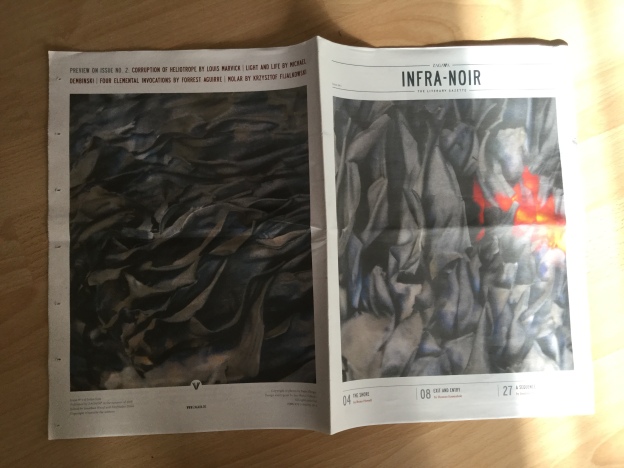
ZAGAVA 2018
Editors: Alcebiades Diniz Miguel & Jonathan Wood
Work by Brian Howell, Thomas Strømsholt, the editors, Chris Mikul, Anon, Avalon Brantley, Luiz Nazario, Nigel Humphreys.
When I review this publication, my thoughts will appear in the comment stream below…

==========================
IN THE FRAME
“The benefits of a digital detox: a few wrong turns bringing a fortuitous discovery and he will have an excuse to use the word ‘serendipitous’ when he arrives.”
Hargadon is Hargadon. And now we have Wilkinson, another of my favourite literary writers, after first discovering him in the SF/Horror genre small press a number of years ago (in Theaker’s Quarterly Fiction, to be precise, and his most recent story, SEPTS, in that magazine, having, for me, an important Ancient Briton link with this latest one in Black Static).
There are several other richly imaginative audit trails and leitmotifs in this relatively brief gestalt of a text. I shall just choose one audit trail for my purpose, the one of seeking signposts to resume a friendship via oblique invitations to an art gallery in an obscure backwater town, after that friend’s sister broke some rule of suicide by inconveniencing others (mostly strangers) through that very suicide. We follow this unmapped soul via supermarket and bowling alley, via an exhibition of blank nemonymous paintings depicting “absence”, shading into a light touch that is noticeable behind the blankness or whiteness, a touch reaching towards an eventual meaning of shapes in the later paintings. Then within the gutter itself of the bowling alley… To reach beneath the skin. Skittled out. Needled out. One gutter of directive significance chosen, while many others then prick out the more one allows the text to haunt you.
“We collaborate and then exhibit anonymously.”
….as do all these stories, without truly knowing they collaborate.
But each story is labelled with a single autonomous name. Absence then presence in each frame. A few wrong turns, but suddenly a wonderful serendipity.
There is much else in Black Static to entertain the Horror Genre enthusiast in addition to its fiction.
“: heat sinks, backplanes, motherboards — and memory sticks, pearl-enamelled like the inside of sea-shells.”
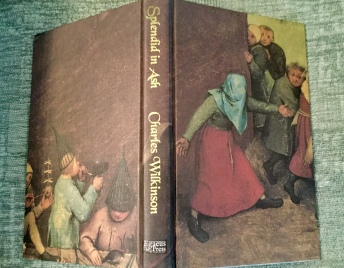
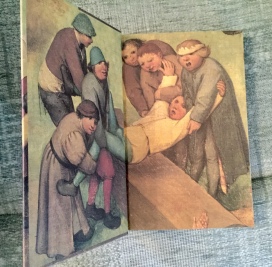
This glorious physical book itself, luxurious, glossy pages, striking cover, sturdy outer boards, publisher’s watermark, is also, it somehow seems to me, the sort of book where I am not surprised to find a story where the narration has a husband’s wife who is frequently referred to as ‘the woman who is his wife.’ As if the front cover is her striving to become something beyond that. Magritte and Brueghel combined. The story itself depicts even more by dint of its words; the man who is her husband has taken over this ancient property in hope of optimising its business potential as a pagan tourist destination. The only problem being that it has a sitting tenant, the “occupier” or “resident-in-perpetuity”, a man who co-opts the wife to service her as part of a closed circuit with little or no ohm resistor, I guess.
================================
SLIMIKINS
“; one moment it was as if the flakes were drifting on a level plane; the next, there was a sense of distance, the spaces between them.”
The flakes, snowflakes, echoing the porridgy attrition of progress in the Devlin-Levy. Here, a striking portrait of how I found teachers and pupils in British boys’ schools when I was at school around 60 years ago, some boys repellent and alien. Some teachers, too. And not to speak of those cross-country runs.
Following the nightmare that led to losing a pupil, Mr Shooter re-trains as a special-needs tutor. While his wife enters that pea-souper of time’s snowstorm called dementia. Invaded by intruders or those who are still left dying from the old days type of winter snow that beset our childhoods. Or is it dementia at all? Or just the God of Assembly wreaking retribution as time and life’s attrition stretches eternally towards death, but never quite reaching that destination, ever yet.
Or so it seems to me. Another Zeno’s Paradox. Or insidious Tontine.
A seminal Wilkinsonite story itself that peers intermittently through onsets of snowy italics.
“, bringing the laws of the undergrowth with him.”
Or the lesson of the undergrowth? An older married couple in a house in the forest, he in poor health, in the process of eschatological down-sizing, I guess. They are expecting viewers to appraise the potential to buy it, subject to their own survey, casing the joint as it were, or the crack in a Staffordshire ornament. And others, like doctor and policeman, with anagrammatised names assessing the colours around the afforested roof and walls, or the integrity of mini-strokes. The best pottery is translucent, I have heard it said. The best poetry, too, and this house-storified endgame for life’s ornamental brexit is poetic, poignant and disarmingly strange.
==========================================
THE WHITE KISSES
I bought this book when I discovered there was a story in it by this author, an author whose works I try to exhaustively collect and study (as can be seen from the link above if you ‘sign in’ there as it were), just like Norvin in this story studies the architectural work of Korcorvian. Beware any Mogson virus though.
I also see that my review so far has been fortuitously centred around the battle between pale and bright colours, as have many of the other works in this book itself. I tried to list the various phrases in the Wilkinson story relating to colours and they are numerous. I was particularly struck with: “One of the man’s eyes was a pale blue, the other discolored: the broken black egg of the pupil had leaked into the iris.” And there is the accretive attenuation towards bleaching into white and more white, via an albino character, to the ice, frost and snow, in this seaside resort, of his wife’s message for which The Mogson is the go-between. Rest assured this is a Wilkinson classic to be added to his other classics. Absurdism on the edge of sheer insidious horror.
And I am convinced one of Korcorvian’s buildings was not the hospice as suggested but the previous story’s Care Home in the White above.
“He seemed cornered by shadows.”
A gem! Essential reading for those of us who enjoy our peculiar craft of literature. Timothy is about to go back to boarding school, as he mixes with the rougher local boys where he lives in the holidays with his parents, doing maths and other lessons with his Dad. We share the tactile and olfactory quality of his thoughts of going back to school, the thud of rugger, and other factors I recognise. I loved algebra at school, but Timothy prefers the straight lines and lengths of geometry. But he is haunted in dreams and elsewhere by this story’s eponymous figure, whether a white-liner, if not -kisser, you will not forget this sinister figure. (An Eightman, not Aick-, I wonder? Still, a figure of 8 has curves not lines, I guess.)
==================================
ABSOLUTE POSSESSION
“It’s ground rent day.”
Or ground hog day? A miniature hedgehog version of it, I say!
I was going to say how CW’s work reminds me of so and so and this and that, but CW really reminds me more of CW himself, and this work is delightful, even caricatural, yes, optimal CW, based on my supertomal survey of his work so far as linked from the above by-line link. No way to describe this unique, haunting work other than as CW-like or Wilkinsonian. Meanwhile, Bernard Hutt (huts are abodes as much as cottages are abodes, subject to freehold, leasehold or this new concept of absolute possession while straddling the Welsh border.) Authors have authority, but I have often given them inferred freehold over their narratives, their narrator or protagonist’s POV being leasehold, and any review of an author’s work needs to pay at least a peppercorn rent to link the absolute possession of some arcane deity who resides ABOVE even the author in authority and what is told below such a deity and beyond any intentional fallacy. I could go on and on about such literary theories as inspired by this work, but suffice to say Bernard, who corks and then uncorks a bottle of vintage wine, becomes a cog in this narrative as he has always been in life while there exist large forces that conspire to divide spire and church from each other. And best to have gone to work in a garage than have aspired to become something better, better, yes, but impossible to attain, like absolute possession of knowledge or of a wife who later left you for an Uruguayan Air Force officer.
A hedgehog as small as a peppercorn, by the way. Fee simple.
=================================
MR KITCHELL SAYS THANK YOU
“It’s low tide. Groynes guide his eyes over the length of the bay; the furthest is half submerged, a jagged line like an alligator’s back.”
Now this work is a highly acquired taste, I’d say. About academic rivalry, neo-Platonism, revenge, a seaside place chosen as the battle ground for such revenge, a genius loci that really exists as a Platonic Form Of Seaside, a hotel like that in Wilkinson’s ‘A World Without Watercress’, and a totemic Elephant emerging from the cliff, if not something even older with its bone or tusk sticking out,,, a work that works well once you have acquired its taste, or once you can get served tastes at all in the Captain’s restaurant…
I have nothing against Mr Wilkinson ever since at least part of me met him “at a university in the north of England” a lifetime ago. I admit I was indeed “a skimmer of texts.”
https://nullimmortalis.wordpress.com/2018/11/17/shoring-up-the-nation-another-report/
“Outside, the hedges, the rowan trees and the eco-friendly units, which had recently been built on the estate, grey shapes are about to merge in thickening November mist.”
Much November mist around today, including that inside me as well as out, not helped by this rather silly story that is not a Wilkinson classic. But still with the characteristic Wilkinson prose style, a genius loci of a small Welsh town equivalent in many ways to Twin Peaks elsewhere, by dint of characterisation and industry. Complete with mysterious murders of young folk in this dead-end economy for them, bringing the town’s average age down even further, no doubt. A rather ‘mad scientist’ or ‘alien elixir’ tale regarding blood exchange and new nonagenarians of a tall nature coming to the town and their impact on the writing by the narrator trying to pin these things down who knew some of the people affected. And red clocks in a yellow sea having hands being turned back
Made too predictable by its own title, there are otherwise some finely wrought Wilkinsonish moments, canapé soggy and ice-cube snacky. A social comedy with frozen edges. A relationship of sexual convenience of the well-heeled couple, haunted by too long a backstory of one of them, floods threatening wine cellars as well as the surrounding Glos. fields, the nearby shopping village, heavy wet overcoats, a sun “leant” not lent, a ‘cumulous nimbus’ and ‘throws’ of a dental disaster. And a firm’s collection vehicle for ice-cube crunchers at the end worthy of being a Samuels conceit.
“Predictably a young man was balanced on top of the roof.”
…as if this bit was inserted after the whole story had later landed at the end of its own flight of fancy. It is as if this author himself – as well as the author-cartoonist called Phil in this story – suffers from catapedamania, i.e. jumping from great literary heights and hoping eventually to fall unscathed, even enhanced, upon a tractable, if strange or disarming, target. This story, for me, works well to target, and, by the end, delivers a link to the question of drawing (or not) with lines, rather than with curves like speech bubbles – or with mere algebra as logical audit trails of plot? This story tells of Phil as diminished by his wife now being the breadwinner, her job being one dealing with asteroids and comets, not astrology, but blatant planetary truth. He strives to be a writer/artist, while the couple’s only son, Matt, continues to nag at them with poignant worries about his catapedamaniac activities. Phil is thus harassed by forces that threaten to halt the story’s targeted fall halfway, and like Zeno’s Paradox may never finish its fall. All mixed with a satire on getting published these days – and continued depiction of the genius loci of that Welsh community we met earlier in this book (to where he and his wife have migrated from London). A place that sounds even more a once quaint place now made crassly modern and nightmarish. Best to stay falling forever, I guess, without reaching the landing mat. Perhaps I’d better return to the beginning of my review above and delete the bit about it landing on target – unless it is now too late to do so?
The tiny legs in the bottom right corner is Icarus.
=====================================
THE SOLITARY TRUTH by Charles Wilkinson
“With re-reading, the full meaning will no doubt become apparent.”
And what comes in and goes out through the cat flap? The foregoing gestalt context of this Black Static set of stories’ palimpsest-dread of person installations etc. — including the earlier parental ones (e.g. parent and daughter) as well as, now, a pet-al palimpsest — makes this work EVEN more powerful. Puckish and pitiful, sardonic and strong. And much more, over time.
“Soon I will start to lose the details…”
…which leads me to my theory of Wilkinson. But first, I can tell you this is an increasingly crackbrained portrait of the narrator’s elder brother, and the relationship of both of them with their two sisters, a battle of inheritance and the sororal scorn for both brothers’ behaviour, I sense, even though the narrator brother maintains a level of self-perceived sanity, a sanity that I question. Who to believe? Do we in fact believe that the elder brother takes some outlandish ‘mad scientist’ type equipment on a trolley to funerals? Why does that elder brother have a theory of Fridays, stemming from their importance in various religions, a theory of both finitude and escape? Why has the younger narrator brother migrated to nowhere off the edge of the North Sea? Or did I misunderstand that? And why do most Wilkinson stories have a similar length? Because he has to finish them by the end of each Thursday, I suggest.
“Never say anything about your work until you’ve completed it. You’ll find that a very useful rule of thumb.”
“He had been a writer of great lucidity and elegance; his use of the semi-colon was impeccable.”
…if not his use of the semi-priapus? This is on one level a hilarious satirical account of a Gentleman’s Club — here a Club for accredited Explorers of the world ranging from having written a single essay in book after one expedition to reaching everywhere even as far as the Interior of the Interior of the Interior…
Our ‘hero’ stalwart of this Club’s traditions is in the single essay category, and we follow him as things change, as he views again the various things killed by Members in the exhibition rooms, spiders and snakes of outlandish qualities, even his own latent snake…. This is indeed a changing world of gender and temperament and politics, and this is essential reading for a new slant upon it. Except I would not recommend it for any distaff readers, as I would not equally recommend my own kindred spirit of a novella called LADIES written in the late eighties or early nineties!
========================================
Might Be Mordiford
“‘No names,’ the man said nervously, although not without a touch of faded menace.”
A perfect segue with the previous story where we were explicitly told by one of the characters that it was not about its eponymous name. Here, not dissimilarly, the names are somehow missing or wrong by default.
Some might say this story is the apotheosis of the Wilkinson canon (see link above), but others might say it is a caricature of that canon. Sir Thomas Browne, included.
A sensorily atmospheric general post office that also has a tea room and dubiously named tenants, post officer and customers, that interact as if in a Pinter or Beckett play plotting coded crimes after a stay in some disarming prison where they first met up. And it also imports an urn from Strantzas’ roof garden….”filled with pale flowers, a green and white profusion, which must have accelerated so fast the stems could not be cut.”
“, but the bond between taxi takers was almost as strong as the solidarity of the last smokers.”
For takers, also read sharers. And the bond in the title itself is important as an ampersand rather than an and. This is the story of two brothers with those nicknames, the eponymous Chair being wheelchair bound, a bit like a mini-taxi, or a quaint Tardis hinted at by a new dimension to their narrow landing, and extrapolations of mooncraft and an internet company in charge of the world, cf Kerblam with an Am at the end from last Sunday on Whovian TV, I guess. This is a near future world where the two brothers suffer changes, as the ‘explorer’ in the Absent Member suffers them, changes in their Faith and the old Language, and the building profile of another small Welsh community like theirs. Leading to a Chair’s stroke engine and the loss of the author’s earlier cherished domains like Prydain, Albion and Britannia. Not Brexit so much as an envisaging of a world where the old-fashioned, meticulous entities that often people this author’s brain need to fend off modernity and today’s lack of faith, but all taking place in a SF world he has here himself created! A paradox like cremation, bodies and souls? A Wilkinson gem.
And, oh yes, I forgot the ghosts.
“The wheel-less car was still on the ridge, although it was closer to the rim.”
The wheel rim or the edge?
“Conjunctions will soon be submerged.”
This is the epiphany of the book. I hesitate to call it merely coda. Starting with a weather scene of rainbows, a scene with a style of depiction to die for – our Welsh community having been reduced to a hill now as an island in the near future floods with a Dream Archipelago beyond. Its once Lord of the Manor type, like a spear version of Alan Bennett’s Lady in a Van, resorts to sleeping in his posh car, now a rust-bucket — or sleeping undiscovered in this story’s couple’s house on the hill. An ageing couple whose distaff side is slowly losing the use of Proper Nouns, later common ones, the spear side being her husband recognising he is losing his wife to such loss of speech rhythms, as he recognises happening in himself later, along with the floaters in his eyes as well as the haunting almost marine floaters outside of them. We as readers merge as floaters with those floaters. It is absolutely incredible material with countless scenes never to be forgotten, an apotheosis of Aickman and Alzheimers. And the Flowers of the Sea story. And more I cannot define, as I lose my own power of words. A poignant miracle of weirdness. Deserves every accolade. As does this whole book. The Mirilkinson of literary absurdism, the soft touch of satire and a sheer empathy of connivance with an overwhelming floater of its own.
“Later he understood he was not certain which side of the skylight the shape was on.”
end