Friday, February 08, 2019

Non-Syncopated Alignments And Corporeal Jurisdictions (Stories) – Thomas Phillips

4 thoughts on “Non-Syncopated Alignments And Corporeal Jurisdictions (Stories) – Thomas Phillips

  1. Sturdy book about 5 by 6 inches, and inclusive of a music CD that I assume to be music by the author. And some striking black and white photos. About 40 pages, restricted to 22 copies plus a few for private distribution. September 2018.
    My previous reviews of this author: https://dflewisreviews.wordpress.com/tag/thomas-phillips/
    And this publisher: https://dflewisreviews.wordpress.com/tag/raphus-press/
    There may be a delay before I am able to read this book.
  2. DISCLAIMER
    Warning:
    I warn you about this warning to the rest of the book, the rest of the book that I have not yet read. This warning itself (a sizeable proportion of the whole text in which it is embodied) may send you mad or make you very frightened, or both.
    I will not be discussing the text-accompanying photographs in this book, other than to say I find them obliquely in synergy with what I am led to expect by this initial warning.
    I intend to listen to the music CD after I have finished reading the text.
  3. ARBOREAL HORIZONTAL
    “Is this Dada or Fluxus performance, or the mere performativity of a child under the sway of self-importance?”
    In a disarmingly aggravated prose that, nevertheless, flows smoothly, we follow one woman or two women, with a small daughter or puppy dog, or both, and car as imagined jet aeroplane, possibly. I wonder if the child got the gender of the person hanging in the tree, correctly.
    This is strangely disturbing to me, especially when I reread my own brief story ‘The Parachutist’ first published in ‘Night Owl Network’ vol 2 No 13 (1993) and first posted to be read here in 2007: http://weirdmonger.blogspot.com/2007/11/parachutist-penguins-at-midnight.html
    “What is veracity in the age of seriously relative truths and imbeciles merely reacting to propaganda.”
  4. HAPTIC WORDS, VOIDS
    “: to retreat ahead of it.”
    From the translation of the de Queiroz poem (Damned Art 1939) by Alcebiades Diniz Miguel to the Francis Bacon ‘New Atlantis’ quote (aptly after which I listened to the 6’ 36” of sound bliss in the CD), I have decided that this book has given me a form of spiritual parachute, although this is not explicitly a good or bad thing, not even explicit at all. And this final work is in fact a form of text bliss (an amazing conceit), by dint of another sound recording, an interchange between listener and sounder, life and death, in Damian-like interview, and my simultaneous review (here) of The Book of Flowering comes into strong mutual synergy. And the naive policeman in the Murakami (here), also simultaneous. I wonder if Barthes had a parachute available?
    end

    Thursday, February 07, 2019

    The Book of Flowering


    The Book of Flowering


    EGAEUS PRESS MMXIX
    Edited by Mark Beech
    My previous reviews of this publisher HERE
    Works by Mark Valentine, Tiffani Angus, Sheryl Humphrey, Timothy J. Jarvis, Ron Weighell, John Gale, Reggie Oliver, D.P. Watt, Colin Insole, Alison Littlewood, Damian Murphy, Rebecca Kuder, Mat Joiner, N.A. Jackson, V.H. Leslie, Jonathan Wood, Charles Schneider, Thomas Strømsholt.
    When I read this book, my thoughts will appear in the comment stream below…

    22 thoughts on “The Book of Flowering”

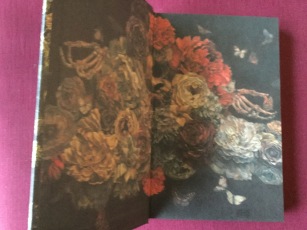
    1. A most beautiful book, as you can see, and pleasing to handle and read. Over 270 pages, and copies restricted to 350.
      ============================
      THE PALE SENTINELS OF ASPHODEL by Mark Valentine
      “Though he was Leys by name, there was no ‘laze’ in his nature.”
      A luxuriantly elegant story so richly deserving of this particular author’s efforts to hone it. The still solid house, but rundown, is rented in the story by the narrator from a R.K. Leys who dies during it. The bequeathed pot-pourri holder and the garden of the house, and the essence of the flowers’ secret scent as loaned by the husks of their petals, and the eventually unfolded findings — beyond any strident eschatologies — of connections between that scent and the god Set, all make me further play around with the words myself and distil new meaning from them, to lay or set down, relay the Redolent Kinaesthetics of Flowers. A medley of cattleyas, and more. Set as Scent. The floral ley-lines veining the ark of history itself.
      My previous reviews of this author: https://dflewisreviews.wordpress.com/john-howard-mark-valentine/

    2. WHAT CANNOT BE DESCRIBED by Tiffani Angus
      “Around her waist, Maria had tied one of her glass jars.”
      “, as any dutiful daughter should, but since the jungle she had treated Maria like a specimen:”
      What cannot really be described, either, is my feeling in reading this fine standalone story, richly orchestrated with jungle mœurs and stoical emotions of mother and daughter, a God’s-face moth and flowers that blend into a Gestalt scent like a God itself as the essential scent in the previous Valentine story that I read yesterday in this book, i.e. my feeling NOW in reading this Angus story that I happen to have read straight after (within minutes) this one called ‘The Stray Curse’, giving me two stories utterly in synergy with each other, by magical chance, as I say. This Angus one is about a mortal mother’s battle (alongside her daughter) to paint the Jungle’s specimen jar, its moths and flowers, before returning to ‘civilisation’ where I, a man “who will not have looked at truth” etc., will now read of her wondrous journey. And the colours that could not be described. The peacock flower, too.

    3. (Possible Spoilers)
      FLORA’S LEXICON by Sheryl Humphrey
      “He noticed a copy of Hawthorne’s ‘Mosses from an Old Manse’.”
      An engagingly old-fashioned story of touching romance between a travelling stationery salesman and she whom he sees as a beautiful woman called Flora, a woman he glimpses one day by a willow as he passes in a stagecoach. Eventually, they dutifully exchange backstories within a constructively fabricated artistic frame of words, their love growing. But tinged, I feel, with glimpses of something naively darker beyond them. A story imbued by a communion with flowers, the language of flowers as a Gestalt of meaning in tune with this book’s earlier archetypal scent as the soul of all flowers, even the meow language of a cat, turning the story’s words themselves into a language beyond Adam, Eve or, inferentially, even Moses, thus strangling the couple’s love with fake news or naive misapplication of what seems to be best. Strangling ‘you’, too, explicitly by the end. A fable for our times.
      The story titles’ typography in this book emblemises this Gestalt language of flowers perhaps, as shown by the next story’s title, a story as yet unread…
      55b0f470-2bee-4b5d-9698-2a86a09ef249

    4. WITH SCOURGES, WITH FLOWERING SPRIGS by Timothy J. Jarvis
      “Black Madonnas in niches in stones by the side of paths, including one that was devouring her son, as Saturn in Goya’s famous painting.”
      A powerful work eventually deploying ricochet points between the various races and religions in Brexit Britain today, as we follow a well-characterised Bulgarian woman living at a campsite near Luton with other East Europeans, she working in a care home. All threaded through with flowering rosemary and thyme images, and a matchbox that twitches… She meets a deceptively beautiful ageless woman in a pub, a sort of eternal Wanderer or Witness (see my reviews here and here) – and she tells our Bulgarian friend of her supposed time in the Spanish Civil War. There are many striking images in this work whence we derive both companionship and antipathy in paradoxical alignment, and from a ‘fragmented’ speech overheard in dream we feel this book’s, so far, strong tentacularity of Gestalt and language. And as to the twitching matchbox, I personally thought of my father’s manufacture for me as a child of a candle-elasticband-matchstick matchbox, now trundling across the plains of history, then eventually arriving at an expended halt with a twitch.

    5. d0ed1f0c-d8f5-46a5-b068-34b0566ea37bFUGUES OF THE BLUE LILLY by Ron Weighell
      “A man whose talk is oxen will dream of oxen.”
      A man seeking his dead wife in the realms beyond life is aided and abetted by a bag lady with the help of this story’s eponymous distillation, and references from Poe’s Usher and other named dark and arcane books whose listing here may be its own inverse “homophony”, I infer. This is an apotheosis of love now unrequited by one of the lovers’ deaths, possibly both, by the end, as meshing of souls and bodies occur in realms described to the nth power of Baudelaire’s Fleurs du Mal – or of stylistic Lovecraft… a name that is its own assonant synonym or homonym? And when I say to the nth power, you would surely not credit the power of effect when you enter the ‘you’ part of the journey here, a reading journey, too, that ever remains the darkly florid language that swaddles it. Weighed in Hell, this eschatology of vision is well worthy of the author’s canon of fiction and of being written under his name. My previous reviews of his work: https://dflewisreviews.wordpress.com/peter-bell-ron-weighell/

    6. (Possible spoiler)
      A GARDEN OF SORROW AND SORCERY by John Gale
      “But this is what the Queen of Faëry had anticipated, for she was now all but certain of what she had long suspected:”
      This story has a style of language that is be-Galed and be-Galing, but only those who have read this author before will know what I mean by this, and there is no way anyone can convey its special nature in a book review. A style, with souls or presences hovering in every archaic compound corner of the words, a style that tells of the Queen, who sometimes visits the Mundane Worlds, as she seeks her own soul — and the garden, with its own secret garden within it, is a rarefied provision of such a soul. This work is utterly something else.
      My previous reviews of this author: https://nullimmortalis.wordpress.com/2011/07/01/allurements-of-cabochon-by-john-gale/ and https://dflewisreviews.wordpress.com/tag/john-gale/

    7. The next story I read and reviewed a week or so ago here: https://dflewisreviews.wordpress.com/2019/01/05/the-ballet-of-dr-caligari-and-madder-mysteries-reggie-oliver/#comment-14650
      Below is what I wrote about it then, in that context.
      ====================================
      LADY WITH A ROSE by Reggie Oliver
      “, vaguely reminiscent of Jackson Pollock but with none of his control and subtlety.”
      …like the Boke of the Divill, as rewritten by a master.
      This, meanwhile, is, genuinely, an engaging, ingenious story, and disingenuously old-fashioned (in a good way). I dare not itemise its plot as it is full of spoilers. A story broadly, then, of a hidden Titian painting of a lady with a rose, and a struggling English painter as narrator in 1960s Rome, hired by a Prince who claims not to be ‘omosessuale’ (he had an affair with Lady Constance Martlesham) and has a thing about not giving out his telephone number — the narrator as hired by the Prince to paint the Titian again, meticulously stroke for stroke, part of which job is to paint the difficult rose, perfectly, of course. I think, however, that I am not sure whether this story is the replica or the original, as they are certain to be identical. The Prince himself differentiates between a replica and a forgery, despite the end result being that they, too, can prove to be identical, whatever the intention. But who is fooling whom? All I know is that the rose can kill if squeezed too hard in passion. And it is a lady with a rose that thus ends this charming, sometimes horrific, book of staged eschatology, with a subtle literary antechamber that threatens to squeeze you into its coffin. Or its misangled cabinet. One or two genuine original masterpieces in this book as well as a few that are not. Some madder than others.
      ======================================
      My previous reviews of Reggie Oliver: https://dflewisreviews.wordpress.com/reggie-oliver/

    8. BUT THEY WITHERED ALL by D.P. Watt
      “; a town that knew so little of our family that it felt compelled, instead, to make up what they didn’t know. I shall return the favour.”
      Not so much a catapult of gossip (even though, in it, you would need to go far to read another such remarkable description of a real catapult shot), but more a boomerang with internal ricochets as well as outward floral tributes that often never came home to roost. This is a deceptively ingenious story narrated by a woman that we suspect is the various women of whom she writes, in a quilted tale of nefarious preternatural recrimination after her father died. Full of roses (another lady who starts with just one) and pansies, plus fish and fennel tarts or rue fancies for funerals. What is invented by her, what is not invented by her: an eternal tussle that no amount of re-readings of this style-enticing story of inferred abyssal flowering paranoia will allow you out of its prison, yes, you, perhaps the only one she seeks out. Though, my name is not Davis, but close enough Welshly. Got me over a barrel. By the way, I think the catapult shot must have hit her head, not her coat.
      My previous reviews of this author: https://dflewisreviews.wordpress.com/d-p-watt/

    9. GALLYBAG by Colin Insole
      “And there were other patterns in the landscape that he could not decipher — like shapes from an old watermark that had faded and merged with its paper.”
      This book happens to bear a proud watermark on its title page as this story is arguably the book’s literary watermark that I cannot imagine fading as such, but perhaps ever merging and meshing with our past and future, giving the expression ‘hidden in plain sight’ a new meaning. I could have quoted most of this story as prime poetic prose of such a feeling, but reading it all is your only path back to the village, with its lime trees and mistletoe, its collision with conscription in the Great War, the return diaspora of its dead, its clearance as a punishment or for utility army means, and the regathering of its ashes and blue flowers, its gallybags, and more, regathered by one man who retrieves names, old postcards and one diary in particular that, as a disarming info-dump, leaks to and from Insole.
      “The goods leak from one emporium to another.”
      A major Insole work that should enable you to recreate or transcend its stated “ecstasy and despair”, whatever the modern inroads against it. I cannot do justice to it here. My previous reviews of this author: https://dflewisreviews.wordpress.com/colin-insole/

    10. DOWN IN THE DENDRONS by Alison Littlewood
      Rarely fatal, the books had said. Rarely. What they didn’t say was never.”
      Rarely stories of childhood betrayal end up told again, but here the narrator, as a man, returns to the garden whence, as they once played together, amid mad flowers and mad honey, his younger brother vanished into the Circles of Rhododendron, a growth and undergrowth now cankered, today. Infecting the trees. Dendron is the Greek word for tree? So what swallows what? And who swallowed whom? I allow this work to flow over me as if it is something more swaddling than being at first glance a work of horror tropes simply worthy of straight horror anthologies – it also has childhood from past more innocent books, too, and a growing “bitter taste in my mouth” about what came after. Down in the Mouth, as well as the Dendrons.
      My previous reviews of this author: https://dflewisreviews.wordpress.com/tag/alison-littlewood/

    11. FLOWER DREAM SERMON by Damian Murphy
      “Transgression loses its savor if you throw out all the rules.”
      An interview with the married partner of Cyril conducted by her close woman friend. Hypnotic and irresistible, this method of narration makes the blend of nostalgia and déjà vu perfectly pitched and believable. A blend, too, of secrecy and openness, taking what I described earlier in the review of Insole as the ‘hidden in plain sight’ syndrome to new levels. Taken towards the inner circle of Dendrons, too. There is no way that this latest Damian Murphy, at novelette-length, can be fully covered here. I was entranced, by the constructively devious games of the married couple, by the smouldering or pent eroticisms, the nostalgia for Tenniel’s Alice, the morphing of city maps into flowers (and exploring those cities in dream reality), and, eventually the ritual path towards a Gestalt of visionary “fragments of a revelation” into a “concise statement” of utter truth. Mischief and obedience. Scriabin and Varèse. And other couples galore. An “extended dialog” between Mentor and Disciple (this interview as its looking-glass image?) – And her perceived marriage with Cyril: the perfect backdrop to this guided journey, that depends just as much on being misguided. Scourge, as well as Sermon, as the moving title of this work as well as the notebook within it (and the flowering book outside it). A religious experience in its own right as well as Murphy apotheosised… “If the piece was magnificent in its original form, it was nothing less than stunning now.” Percolator, percolator, percolator, percolator …
      “…delighted and disquieted to find that every image in the book had morphed into the form of a flower.”
      My many previous reviews of this author: https://dflewisreviews.wordpress.com/tag/damian-murphy/

    12. 7F9D5A98-9D50-43B4-9CBD-6B33046CECE9THE ONLY FLOWER THAT MATTERED by Rebecca Kuder
      “I had yanked the dead Queen Anne’s lace from the ground, roots dangling.”
      Also known as Daucus Carota. Begins with the first three letters of Daughter, by coincidence or subtle design, too subtle for me to divine. Meanwhile, another story that is something truly special among many in this book, where it is impossible to deem one the Favourite. This is of a waif imported as maid servant from a waifs’ home to a large memory-filled house a hundred or so years ago, one too large for the dried up couple who live there, their son seeking his fortune endlessly in the world, and daughter Eliza dead after being left behind when her parents went elsewhere hunting zebra et al. Only a vase of weeds or disguised flowers can tell the story perhaps of that tragedy and the affective haunting of the house by the daughter, and our growing knowledge of the servant waif’s stoical life. Her small pleasures, like seeing ‘sugar flowers’ left on a food plate. Red roses and “sideways water” and “brittle paper story.” Exquisite work, with “small kindnesses” and anguish.
      My previous reviews of this author: https://dflewisreviews.wordpress.com/tag/rebecca-kuder/

    13. BEBYNE’S LANE by Mat Joiner
      “If you were desperate enough, any hollow could become God.”
      Merlot-drinking, memory-haunted, the ageing man, divorced and now alone, experiences pareidolia from whatever lurks in the flowering bindweed, bynebeing, of his garden, haunted by his own acts or accidents that he had hidden in the plain sight of his backstory. His own disloyalty and concealed crime. The crime was not really the love, or crush. but a hidden crash… I was not surprised that he liked solving chess puzzles and had a nephew called Xan, a nephew with his own husband, a Xan whose next move was to somehow merge or morph into the Brummie victim of the crash. And an ex-wife with whom he still shared remaining in the EU during Brexit, while he whom he loved also perhaps merges with the “sunny lad”, the once promised sunny-uplands? Till, like a chess problem, the moves are made to transcend the beast in the hollows of the bindweed, tearing down this book’s earlier Dendrons. This Joiner of memories a darkly tantalising tale of guilt and reclamation.
      My previous reviews of this author: https://dflewisreviews.wordpress.com/tag/mat-joiner/

    14. A PHANTOM FLOWERING by N.A. Jackson
      “: night-scented stocks and nicotiana. Jasmine and honeysuckle twined round the rusting metal framework of the balcony.”
      Krauss’s Last Balcony, one might say, as, in tune with the previous Joiner, where the past, including Krauss’s deceased wife’s spikiness, are reclaimed or brought back unwillingly, here not by bindweed so much as nuclear waste after a meltdown near the River Dnieper. He is a scientist exploring the sometimes floral array of his specimens when investigating the meltdown, and he finds attractive the dumpy cleaner of the Portakabin where he has ended up working. He follows, without knowing he follows, that person, in a haunting Ishiguro-Unconsoled sort of way, ending with scenes you will never forget, however hard you might try. A natural unfolding-in-concupiscence. A poignant passing, passing away and transference of tactile binding pollen (?) via erotically inhabited flowering-growths…which brings me obliquely to a new meaning perhaps now given in hindsight to the binding of the Joiner?
      My review of this author’s collection: https://nullimmortalis.wordpress.com/2010/08/15/visits-to-the-flea-circus-by-nick-jackson/ and reference to his story in Nemonymous as Zencore: https://zencore2007.wordpress.com and Still Life in Horror Without Victims: https://nemonymous123456.wordpress.com/596-2/


    15. THE ABSENCE by Jonathan Wood
      “This was the blissful experience amidst the silence and the canvasses and the worlds within the wallpaper and silences within the domes.”
      A museum out of season, and its curator/caretaker’s thoughts upon the original joblot collection that once came here, a blend of permanence and impermanence, dried flowers and their once concomitant freshness, the bespoke wallpaper so beautifully described, as is everything, to cut is to grant life, the artistic arrangement of taxidermy and life for appreciation perhaps only for child visitors to the museum – building into the dried-flower books’ binderies the bindweed earlier in this book, and its pollen, and in one instance, Jackson’s description of a sexual act, even cacti connected with a Lily to compare to an earlier Lydia and cacti? A wonderful apotheosis of merging with or into a rich wallpaper of words, clocks and roses, Japanese anemones, as a catharsis of death and life in due season, “that very moment of knowing.” This book one day may be even more valuable in a ‘distressed’ state than in its original newness when I received it? I have done my best during my reading and review!
      My previous reviews of Jonathan Wood:
      https://nullimmortalis.wordpress.com/2013/03/06/the-new-fate-by-jonathan-wood/ and https://dflewisreviews.wordpress.com/tag/jonathan-wood/

    16. THE FLORAL SEASONS OF LIFE by Charles Schneider
      “In the Summer of my Life
      I chose the Lily to be my wife.”
      An exquisite poem of four stanzas, each dwindling to a sudden musical ‘dying fall’, assuming one CAN dwindle suddenly! This poem is utterly in mutual synergy with the Jonathan Wood work, and the rest of the book, this being the first of what promises to be two codas to the book’s still flowering lexophony. Codas or “the secret Codes / of Flowers and Life,”…
      My previous reviews of this author: https://dflewisreviews.wordpress.com/tag/charles-schneider/ and https://nullimmortalis.wordpress.com/2011/06/22/the-mauve-embellishments-by-charles-schneider/

    17. My previous reviews of Thomas Strømsholt – who wrote the last story below – here: https://nullimmortalis.wordpress.com/2013/02/27/o-altitudo/ & https://dflewisreviews.wordpress.com/tag/thomas-stromsholt/
      THE BOOK OF FLOWERING
      “… a heavy heart and an ugly head, to quote Burton.”
      Mine shown as was taken yesterday by self-obsessed selfie, as if I am speaking these last words about this whole book, speaking silently. This last work by Strømsholt is the perfect ending to the perfect experience of this book’s gestalt of life and death seen florally. Perfect is glib, true, but true.4C0C60E6-E684-4CF6-9F5C-3DCB73FF360F
      A man inherits a property full of books and an overlarge garden, the garden with which he uncharacteristically becomes obsessed. And watched by the bookish narrator who is his lover, I guess, and lives there with him. The eponymous book is a herbarium to match Wood’s dried flower books, as ‘curated’ by the previous owners of the house whose selfies were more lethal, I guess. The new owners, as it were, now start curating it, distressing it, too.
      680F5F7A-0DF1-4766-903E-E53438133F97
      end


      Monday, February 04, 2019

      All The Names They Used For God – Anjali Sachdeva

      12 thoughts on “All The Names They Used For God – Anjali Sachdeva

      1. THE WORLD BY NIGHT
        “…the smoked glass will hide the ways her eyes shake.”
        An obliquely naive, illiterate girl travels tunnels and obscure pathways beneath the prairie towards what I might call nemonymous night via a journey by Verne. With white things in the dark. Haunting for me, and with her irises still shaking, she goes there and back to her home, Gretel without her Hansel, to where her Zachary has left, but with oblique letters, that she can’t read, between them. One passing boy squatter in her house reads one of these letters aloud, as she can’t read, but I wonder if he does read it right, because of wanting himself to be her new husband? Whatever, she knows enough to go under for good.
      2. GLASS-LUNG
        “; what had appeared to be smoke was in fact glass fibers as fine as thistledown…”
        …a remarkable resonance with the quote I happened to choose yesterday for the first story in this book. Such synchronicities help to prove to me the inherent worth of a book. This one is a longer story (with certain indefinable hints of Nabokov’s stories that I happen to be currently reviewing here) of a widowed Danish émigré in America with his small daughter Effie, who grows up during the course of the plot. He has an industrial accident to his lungs, a magical realism stemming from his hawling in a steel furnace, and the diversifying business surrounding the quote above. Effie and her eventual employer take him to Egypt as ‘chaperone’ where his fulgurite totem becomes a dowser that promises to outdo even the discovery of the tomb of Tutankhamen… well at least enough, in the first instance. As an old man myself, I know old men deserve illuminary stories like this one told about them. For self-stoical as well as altruistically rewarding reasons. Any ricochet of translucent splinters, notwithstanding. Holding one’s breath for what comes next in his life.
      3. LOGGING LAKE
        “You like industrial chemistry?”
        I found this chick-lit story a compelling read. Written by a chick about a chick but from the point of view of the bloke, a bloke who had created himself anew following his ex who, as another chick, had not found him ex-citing enough. His new chick takes him trekking in Montana, and his cultivated bravado and her harmonising with the wolves outside their waysided tent…. but any more and I would spoil it for you. Even an old bloke like me can envisage, in another time, another world, going on a Picnic to Logging Lake, or even to Hanging Rock. If, one day, I ever manage to come back, I can wear it as a badge of fascination and pull the chicks again.
      4. KILLER OF KINGS
        “One might unearth almost anything with enough searching. Being a muse is mostly this — a sifting through of memories to find something of merit, hauling it to the surface where it can shine.”
        This is John, with snow or static inside his head, his work, as mutual muses, with an angel of feminine pronouns, and builds his own work, till the angel becomes a he? The different pronouns they call God? Blind or just seeing things that are more real than real, sometimes John accidentally writes his lines of inspiration on top of each other and thus makes them illegible to others as well as to himself as he forgets what he has written in such a state of inspiration. This work seems written as if it was always meant to be, an archetype literature that is perfect as you read it, but if left unread will remain inchoate. The ending with the calling of the maid is a perfect example of this. John’s backstory as a teacher, too, and his own palms are painted red with stripes, or left unread with them. Pinned upon each other like angels. Means justifying the ends. Harmonising with wolves? Glass splinters in the lung? The girl with shaken irises?
        “…, mining truth and smelting arguments together until he had built a palace of reason.”
      5. ALL THE NAMES FOR GOD
        “, like my brain was trying to throw weight on the other side of a scale against all the madness that was happening around me.”
        The God in the title is Allah, I guess. The Abuja narration by a girl called Promise (brought up as a Christian, unless I have misread it) about herself and her friend, another girl called Abike, who, after being kidnapped as schoolgirls by Muslim men (Boko Haram?), develop telepathic powers of persuasion over men. Like telling one of their husbands to sit in the corner and recite all the names for God. Promise returns to her family one day, and discovers her small brother is now tantamount to a man. Her powers are tempered against men, as a new wisdom dawns, I guess. Power is not in creating submission but in sharing power, perhaps, whoever you are. Promise, one of the names of God as Goddess?
      6. ROBERT GREENMAN AND THE MERMAID
        “He dragged his fingers slowly through the water, imagining for a moment that he could feel the plankton in it, all the thousands of invisible creatures that float on the surface of the sea.”
        …as I do with this book, I feel, while hawling up, in this particular shape of water story, both a normal and abnormal dreamcatch. This will become, I am sure, the archetypal mermaid story that we shall all grow to know and love, telling of a relationship between a long haul trawler fisherman called Robert and a mermaid. Their physical interaction is magical reading, and if I gave you any sense of it, that would spoil your pleasure when first reading about it. And the huge shark she follows. And Robert’s wife back home dwindling in his affections, as a result. Poignant with emotions deeply fished. The real green man, called Mark, green in the sense of being a beginner fisherman, susceptible to seasickness and interference. All makes for a sleek story of some depth. Sleekness and depth, meanwhile, lead to the need of having small breasts; I never thought of that, till now. The optimal shape in water.
      7. ANYTHING YOU MIGHT WANT
        “…and digging himself deeper until he dug himself right down into Gina’s father’s coal mine,…”
        Impossible to plotify this story other than by reading it as a whole, but it all seems emotionally honest, even though some of the characters deceive the other characters, deceive even themselves. The story of Michael and Gina, escaped from her father who had held them both under his financial thumb, this couple becoming a would-be Bonnie and Clyde? No, because one of them, scared of his own shadow, is seeking a Yellow House not a a Yellow Brick Road, a house with a red swing outside, a house housing Michael’s ex and his handsome little son with curls. But, Gina, when abandoned, is tended by a disarmingly altruistic old man, before she randomly by chance is due to be a waitress at a certain marriage feast….
        And it is the Gestalt itself that owns the emotional honesty, I guess, not the individual people who make up that Gestalt. A Gestalt that wants what it wants and has no mercy but to let its own real-time audit-trail pan out to get it. Circumventing human fickleness and any inborn sincerity trying to express itself person by person, transcending such fickleness?
        Gestalt, one of the names they call God?
      8. MANUS
        “One day the sight of someone with fingernails is going to be enough to make you stop dead in the street.”
        Manus, a word that, makes me think of hands that are like the small ones Trump waggles about as he talks with his puckered anus mouth! Think about it, if aliens visited Earth and they asked to meet our main human leader, they would have to be introduced to him! The one they get first, in other words! Maybe, all is meant to be. This is a story that you will not forget easily. Masters as aliens who look like snot. Their enslaving of the human race by replacing our hands with fork tines. A process in ordered piecemeal, one by one, until all are done. We follow, in this story, one man and the people he knows, his relationships, as each one is eventually forked, including himself (out of order!). All taken for granted, deadpan… except underneath it all, we rebel, or some of us do, some of us at first. All related to certain parts of all the previous stories in this book, now due — in the process of private exhibitionism that will clinch this story being tattooed on your mind — to be made Gestalt. The big picture. But can any one of us see the big picture. Well, yes, I guess. At your service.
        “The one that’s all of them.”
      9. PLEIADES
        “She starts peeling the dead skin off her arms, piece by piece like she’s stripping wallpaper, absentminded the way that some people chew their fingernails.”
        Del (Adelpha) is one of seven identical girl septuplets named after the names of the seven Pleiades and as born to parents who had a ‘mad scientist’ supremacy wish, but, in some eyes, they gain their punishment by dying piecemeal one by one, leaving Del as the last sister – in or out of Manus order? The sisters had thought they shared one brain: but they became a Gestalt of selves shrinking from within or peeling at the edges. And when Del — having given up being narrator as the last sister alive — passes the duty of narration to a man called Troy (as singular Story?), he describes being picked up by Del in her car, and his seeing that her own Gestalt of body-health is also shrinking from within. And peeling from outside as an under-the-skin hitchhiker-syndrome. A most poignant ending as she starts to die, still in contact with her dead sisters, on the beach. Made me forget forever that I became DeL as part of the Pleiades…. A fine coda to this otherwise unforgettable story symphony in this whole book. We now share the one brain or the one name of God?
        “; my fingers sink into it, and below them the shuddering of her heart.
        ‘This is what I feel all the time,’ she says, ‘only it’s the whole world beating.’”
        end