
There was a definite atmosphere in the old-fashioned parlour - except there was nobody there to feel it. The ancient TV seemed dead in one corner, but the huge wireless set in another corner was lit up like a cruise ship, tuned to a gap between stations, a gap that added a hiss to the atmosphere.
A ghost was sitting in a third corner like someone's grandmother used to sit there, and indeed the hiss had clacking knitting-needles added to it. An atmosphere gradually being DROWNED in SOUND.
On the floor was a glint - and the ghost bent to pick it up, intending to add it to the woollen waistcoat she was knitting, to see if the silver button suited it, to appraise its position for sewing it on, given the materials.
There were many shadows in the parlour, although the light-bulb hanging from the ceiling rose was not switched on. There was, you see, sufficient glow from the hissing wireless to set shadows free. But one dark shape in the fourth corner was not a shadow at all; it was a coal bucket beside the companion set that looked like a man in armour with the shovel, brush and tongs hanging behind it, glinting, too, from the wireless glow. The bucket's hills of nuggets were of a blacker black than itself, those hills themselves setting free their own shadows against the chintzy wallpaper.
A pity there was still nobody there to soak in the atmosphere, and now even the ghost had been SUBSUMED by the GLOOM, absorbing, indeed, its own human shadow like dark blood. The ghost was now so impersonal, it could no longer be called 'she', no longer someone's grandmother. And without her, there could be no hope of anybody to remember what or who had been there.
The TV screen stayed jet black with no ghosting double-images. The wireless dead, too, now, having sailed away into its own past, cruising the island memories of nobody. Casting on, casting off, casting on, casting off, to the sound of silent needles. Its captain castaway without his silver button.
www.nemonymous.com
Des Lewis - GESTALT REAL-TIME BOOK REVIEWS
A FEARLESS FAITH IN FICTION — THE PASSION OF THE READING MOMENT CRYSTALLISED — Empirical literary critiques from 2008 as based on purchased books.
Saturday, March 22, 2014

Tuesday, March 18, 2014
Kadath as Life's Ohm Resistor
From my review of Laurence Sterne's 'Tristram Shandy' HERE:
Having slept on the concept, ‘life interruptus’ or ‘coitus interruptus’ in the context of this book — I fitfully dozed and dreamt of an ohm resistor (a kadath?) in the vital circuit of life, pain, regeneration, hope, despair, fear of death, death itself, in the context of the books I have been recently reviewing as a gestalt: Tristram Shandy’s resistor conveying a digressing from this onward and backward circuit so as to maintain it forever without pain (doomed to failure, ironic or not?) – and Virginia Woolf’s stream of consciousness never reaching beyond Q in the alphabet of this circuit and Joyce’s stream of consciousness in Finnegans Wake, riverrun to riverrun, is indeed a pure circuit with the ending becoming its beginning, sown with many resistors in the form of words as captcha codes, Lovecraft’s ‘Dream-Quest of Unknown Kadath’ indeed being my own dream quest last night, sown in its turn with resistors of indescribability, unwhispered-of myths, things we should not know, leading to a dilemma of not between truth and fiction, but between both sides of the truth in this novella’s remarkable last dozen pages (please also see my recent review of ‘Letters from Oblivion’ by Andrew Condous).
Having slept on the concept, ‘life interruptus’ or ‘coitus interruptus’ in the context of this book — I fitfully dozed and dreamt of an ohm resistor (a kadath?) in the vital circuit of life, pain, regeneration, hope, despair, fear of death, death itself, in the context of the books I have been recently reviewing as a gestalt: Tristram Shandy’s resistor conveying a digressing from this onward and backward circuit so as to maintain it forever without pain (doomed to failure, ironic or not?) – and Virginia Woolf’s stream of consciousness never reaching beyond Q in the alphabet of this circuit and Joyce’s stream of consciousness in Finnegans Wake, riverrun to riverrun, is indeed a pure circuit with the ending becoming its beginning, sown with many resistors in the form of words as captcha codes, Lovecraft’s ‘Dream-Quest of Unknown Kadath’ indeed being my own dream quest last night, sown in its turn with resistors of indescribability, unwhispered-of myths, things we should not know, leading to a dilemma of not between truth and fiction, but between both sides of the truth in this novella’s remarkable last dozen pages (please also see my recent review of ‘Letters from Oblivion’ by Andrew Condous).
Saturday, March 15, 2014
Virginia Woolf - Laurence Sterne
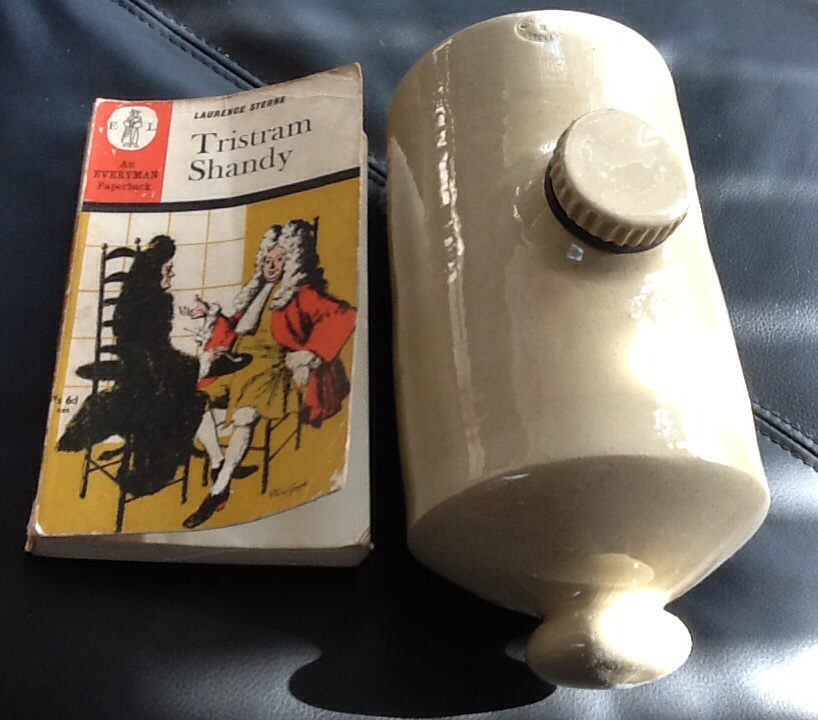
My gestalt real-time review of this 18th Century novel HERE.
Incorporating a potential thesis on this comic novel as a tract of Antinatalism and Internet Grooming.
--------------------
“Nor does it much disturb my rest, when I see such great Lords and tall Personages as hereafter follow;—such, for instance, as my Lord A, B, C, D, E, F, G, H, I, K, L, M, N, O, P, Q, and so on, all of a row, mounted upon their several horses,—”
After due investigation, I seem to be the only person in the world to have noticed, in connection with the above ‘Tristram Shandy’ quote, that Mr Ramsay in Virginia Woolf’s ‘To The Lighthouse’ always foundered on getting past Q in the alphabet!
Tuesday, March 11, 2014
Upper Dreamland
--> Page 328
I listen to Richard Strauss's Oboe Concerto as I read this section, sinuous as a dreamland riverrun or a gentle bleating of pipers as Gugs, ghasts and ghouls hop and machinate around them. I wonder about other contemporaries of HPL, wherein a dream-quest to unknown Kadath might figure, unknown because not overt, indeed hidden beneath their works. Evelyn Waugh. Patrick Hamilton. Lord Dunsany. James Joyce. WB Yeats. Howard Carter. LP Hartley. Richard Upton Pickman, the painter, himself a named ghoul in this HPL tract of travelling back to 'upper dreamland' - another 'approximate human being', "naked and rubbery, and had acquired so much of the ghoulish physiognomy that its human origin was already obscure."
Stephen King's Dark Tower series (the whole of which I real-time reviewed here) has levels of dreamland, some pecking order of reality close to the waking worlds, with characters changing as a result like Susannah-Detta, as they travel through the Todash doors. This Dark Tower series is also full of ostensible 'nonsense' words gradually assuming meaning like that of Todash, KA-teT etc etc: another close shave with Finnegans Wake.
HPL in this section of KAdaTh pages: "...in abysses nearer the waking world." -- "...for he knew nothing of the way from Leng to Ooth-Nargai, and was likewise reluctant to awake lest he forget all he had so far gained in this dream."-- "...grotesque fragments of monuments..." -- "There was no living denizen about, for Zoogs shun the mysterious door in fear,..."
Extract from my real-time review of 'The Dream-Quest of Unknown Kadath' by HP Lovecraft HERE
I listen to Richard Strauss's Oboe Concerto as I read this section, sinuous as a dreamland riverrun or a gentle bleating of pipers as Gugs, ghasts and ghouls hop and machinate around them. I wonder about other contemporaries of HPL, wherein a dream-quest to unknown Kadath might figure, unknown because not overt, indeed hidden beneath their works. Evelyn Waugh. Patrick Hamilton. Lord Dunsany. James Joyce. WB Yeats. Howard Carter. LP Hartley. Richard Upton Pickman, the painter, himself a named ghoul in this HPL tract of travelling back to 'upper dreamland' - another 'approximate human being', "naked and rubbery, and had acquired so much of the ghoulish physiognomy that its human origin was already obscure."
Stephen King's Dark Tower series (the whole of which I real-time reviewed here) has levels of dreamland, some pecking order of reality close to the waking worlds, with characters changing as a result like Susannah-Detta, as they travel through the Todash doors. This Dark Tower series is also full of ostensible 'nonsense' words gradually assuming meaning like that of Todash, KA-teT etc etc: another close shave with Finnegans Wake.
HPL in this section of KAdaTh pages: "...in abysses nearer the waking world." -- "...for he knew nothing of the way from Leng to Ooth-Nargai, and was likewise reluctant to awake lest he forget all he had so far gained in this dream."-- "...grotesque fragments of monuments..." -- "There was no living denizen about, for Zoogs shun the mysterious door in fear,..."
Extract from my real-time review of 'The Dream-Quest of Unknown Kadath' by HP Lovecraft HERE
Sunday, March 09, 2014
HP Lovecraft and James Joyce
I sense that HPL’s greatest fear is himself and his ability to write of distasteful things, not fear of the things themselves. Hence the ‘forgotten’ dreams, the-things-that-must-not-be-described or even mentioned, while he is captive to the dream, not Carter’s dream but the dream of writing about it.
This is an Extract from my real-time review of 'The Dream-Quest of Unknown Kadath' HERE
This is an Extract from my real-time review of 'The Dream-Quest of Unknown Kadath' HERE
Wednesday, March 05, 2014
Edwardian Pram
I do not know why they called it an Edwardian Pram; it seemed quite timeless to me, more 1950s than anything. But then someone suggested to me that it might have belonged to someone called Edward, with that being the era of the so-called Teddy Boys in Britain - guys in lounge suits, winklepickers and quiffs named after a King Edward who gave the word Edwardian its derivation...or have I got my history completely wrong? Not that Edward owned the pram as such, if that was the name of the baby who was originally pushed around in the pram. That particular jurisdiction of ownership was down to Edward's parents who hopefully bought the pram from a posh shop pre-dating Mothercare...
If I could travel back in time to the 1950s, you'd probably call me the Doctor. Well, I am a doctor, but not that time-travelling sort. A Doctor of Philosophy. Not philosophical philosophy as such, because, frankly, I don't know my Kant from my Descartes. No, my Social History degree is in the customs and artefacts of twentieth century Britain...which brings me back to that pram. That Edwardian Pram. And, yes, you've guessed it. It was the pram itself that was the time-traveller. Or is.
The clever question to then ask, I suggest, a question worthy of a Doctor of Philosophy like me, is that, if the Edwardian Pram can travel through time, does that necessarily mean that any occupant of that Edwardian Pram will go with it to wherever or whenever it is going? We do take certain ideas for granted, but my research meanwhile is intended to question them. When we see those Edwardian gents board an HG Wells type contraption like the one he called a Time Machine, we always assume that it will take those gents with it and one day they may become Teddy Boys in the 1950s or modern people with nothing but computers and iPhones today. But my strong factual belief is that only inanimate things like a pram or other contraptions can travel through time - but the human passengers of those contraptions will simply be left behind. That is why all those stories about the Tardis carrying passengers through time is so far-fetched.
You may feel that I am exceeding the brief of my Social History Doctorate in studying matters like who or what can time travel. But why I am here today, in front of you all on the stage in this lecture hall, is to demonstrate that such things are vitally entwined with the very fibre of our social interaction from the Twentieth Century onward, a period of our history when most of us here were born. You see, you were hand-picked to be invited to this lecture. This is really an experiment, rather than a lecture, but it's probably both. Ah, I see you are shuffling awkwardly in your seats. You obviously think I am mad. But be patient. All shall become clear ...eventually. But do feel free to leave if you wish. Good. I see that only one person has left. More or less as I expected.
Well, before I reveal the Edwardian Pram itself - indeed it has not yet arrived - let me tell you one further thing about yourselves, assuming, that is, that all the small talk among you before I arrived on the stage has not already revealed a certain specific common factor true to everyone here, even to that person who has just left the hall.
You may think some of you look slightly older than others, and therefore some look slightly younger than others, too. But you must have at least realised that you are all likely to be from the same generation. But let me tell you that there is one particular year in your era of birth, a year that all statistics and subsequent research has shown, with the give and take of some good fortune and some bad fortune in what has been made available by successive British governments since that year, yes, that year, when all of you, yes each and every one of you, was born, yes, that year, your year, was the luckiest of all years to have been born, when taking everything into account. Yes, I now see you all looking at each other and smiling as realisation dawns. Each of you already knows in which year you yourself was born, and now you know in which year everyone else around you here now looking at you with a knowingness in that look was born. Yes, that year can no longer be a secret, that year was 1948.
But I know it wasn't all good to have been born in that year. Some of you have had hard lives, harder than some others here. I think you can tell which of you have had the hardest lives simply by looking at each other, searching the eyes of your near neighbour in the audience. That's the way of life. But generally speaking, when taking the rough with the smooth, by the law of averages which is more than an average law, it is definitely true that 1948 was the best year to have been born in the Britain of recent generations. So congratulations to you all.
I just heard someone call out that some people born in 1948 are already dead. Yes, you will all die in all probability relatively soon, especially as you are today nearer 70 than 60 years of age. How lucky is that, I hear you ask.
But that takes no account of the Edwardian Pram.
Don't look mystified. There is no mystery about the Edwardian Pram. It just is. It just was. And it always will be. Moving from generation to generation, or even leapfrogging generations. Itself created in a lucky or unlucky year of manufacture like your good selves.
I'll let you meditate for a few moments...
Don't look round: it is trundling down the central aisle from the back where the entrance to the hall is. Some of you at the back have already seen it pass by your row of chairs, and those of you at the front will see it soon. Don't look round, I said! It is unlucky to look round and see it before you were intended to see it. Its wheels are squeaking, groaning even. Well, after all, it's older than you are. What do you expect?
But now it's gone. It has moved to another year, another generation, perhaps even to the end of time itself. It can't collect passengers as passengers cannot travel in time; only things can do that. That's my genuine factual belief. Even if it could take passengers, it would have to be a baby, because only a baby would fit. Or two babies at a push.
But did you see someone pushing it just now? I see some of you at the back nodding. Forgive me, but you at the back look happier now than those in the front. It's as if you at the back have realised what life is all about, what my experiment here today for my doctorate is all about, too. Proving something against the grain of one's original factual belief. You at the front should feel happy too. So long as you didn't look back.
Ah, I see what has now happened. But I didn't see it when it happened. It just is. Perhaps it always has been. Emptiness often creeps up.
You were the luckiest, after all. Not just some of you, but all of you. Gone wherever forever.
Anyway, just think about it. If a large hall of empty chairs can think about anything at all. You were definitely the luckiest year's generation. Still are. Always will be. I envy you. But at least I have the satisfaction of a successful counter-factual experiment and my doctorate assured. Sometimes you have to make the best of a bad job. The best of a bad year to be born in.
You see I was once a Teddy boy. Born in 1935.
By the way, I know I am now lecturing to nobody at all, only to those rows of empty chairs, but I can at least tell you chairs that the pram you saw or at least heard was the pram my dear late lamented Mother pushed me around in, a pram that was then secondhand and still in use from the Edwardian times of HG Wells. And she was still pushing it today in 2014, from what I could see of her from up here on the stage.
Anyone got a tissue for me? Perhaps you who left early would be so kind.
Saturday, March 01, 2014
The Galaxy Club by Brendan Connell
 "And that stick might work against fish or dragons or plaster virgins, but it won't do much good against the Galaxy Club."
This is a book's book. One that I deem will be found necessary to be carried around in the pocket at all times - not as a good luck charm or a lofted cross to ward off or comfort some Brer Fox or goat crucified by the nearest tree - but potentially as an unmapped beaten road bible, or a dream-catcher, one that you can wryly resort to when the electricity is turned off and Kindles get too damp to ignite words. Permanently re-readable. Dog-eared is best.
"A long time ago it was my father who boarded up the Devil."
"And that stick might work against fish or dragons or plaster virgins, but it won't do much good against the Galaxy Club."
This is a book's book. One that I deem will be found necessary to be carried around in the pocket at all times - not as a good luck charm or a lofted cross to ward off or comfort some Brer Fox or goat crucified by the nearest tree - but potentially as an unmapped beaten road bible, or a dream-catcher, one that you can wryly resort to when the electricity is turned off and Kindles get too damp to ignite words. Permanently re-readable. Dog-eared is best.
"A long time ago it was my father who boarded up the Devil."Extract from my review here: http://dflewisreviews.wordpress.com/2014/02/26/the-galaxy-club-brendan-connell/
Thursday, February 27, 2014
Tuesday, February 25, 2014
The Real Absence
| Posted on Tuesday, February 25, 2014 - 04:11 pm: |
I've just read and reviewed most of FINNEGANS WAKE by James Joyce who, like me, suffered from recurrent iritis.
Why have I only read and reviewed most of it? Well, you'll have to read my review to get to the point of Real Absence...
http://dflewisreviews.wordpress.com/2014/02/05/finnegans-wake-james-joyce/
Saturday, February 22, 2014
Capsflap
CAPSFLAP n.
An alternative name for the eye condition commonly known as iritis or uveitis.
Derivation: Finnegans Wake: James Joyce (1939)
Derivation: Finnegans Wake: James Joyce (1939)
The Backwards Aladdin
Excerpt from my real-time review here of FLASH IN THE PANTHEON (Gloomy Seahorse Press 2014) by Rhys Hughes:-
The Backwards Aladdin
"You can't wish to be something you already are."
Absurdity gives birth to wise truths, often simply with a single ricochet from an infinite niddala of mutual rubbings by souls that possess things to be rubbed and with which to rub.
To be woken to each day by these Hughes' fictions is to wake indeed. Each a fastbreak flash to ignite my brain.
An aging brain, though. There's the rub.
The Backwards Aladdin
"You can't wish to be something you already are."
Absurdity gives birth to wise truths, often simply with a single ricochet from an infinite niddala of mutual rubbings by souls that possess things to be rubbed and with which to rub.
To be woken to each day by these Hughes' fictions is to wake indeed. Each a fastbreak flash to ignite my brain.
An aging brain, though. There's the rub.
Monday, February 17, 2014
Gary Budgen - Souvenirs from Sanctuary Street
Extract from today's real-time review of BFS JOURNAL #10 HERE:


Wednesday, February 12, 2014
Jamjoyance
I arguably coined these words and expressions: ‘zeroism, egnisomicon, egnisism’ in conjunction with PF Jeffery (1967), ‘whofage’ in conjunction with PF Jeffery (1973), ‘agra aska’ (1983), ‘weirdmonger’ (1988), use of ‘brainwright’ in modern times (1990), Salustrade (1992) use of ‘yesterfang’ in modern times (1997), ‘wordhunger’ (1999), ‘nemonymous, ‘nemonymity’, late-labelling, veils-&-piques’ (2001), ‘denemonise’ (2002), ‘megazanthus’, ‘weirdonymous’, ‘chasing the noumenon’ (2003), ‘wordonymous’, ‘wordominous’, ‘the-ominous-imagination’, revelling in vulnerability (2004), ‘a woven fire-wall of words’, ‘the synchronised shards of random truth and fiction’, ‘nemoguity’, ‘vexed texture of text’, ‘fictipathy’, ‘nemotion’, ‘the hawler’, ‘the angel megazanthus’, ‘klaxon city’, ‘horrorism’ when used as a word for the philosophy of horror fiction (2005), ‘publication-on-reading’, ‘antipodal angst’, ‘the tenacity of feathers’, ‘a writer’s mandala’, ‘wordy weird’, ‘nemophilia / nemophobia’, ‘magic fiction’ as the obverse of the more common expression ‘magic realism’, ‘weirdtongue’ as the ‘name’ of a language, ‘Glistenberry’ as an alternative name for ‘Glastonbury’, ‘tonguage’ as a ‘conscious’ language, ‘yester-eggs’ as a term for Proustian ‘selves’, ‘the parthenogenesis of reality from artifice’, ‘all is for the pest in the pest of all worlds’, ‘Baffles’ as fables with muffled morals (2006), ‘fanblade fable’, ‘abutting the if’, ‘word clones / word clowns’, ‘bumps for books’, ‘rite of review’, ‘cone zero’, ‘a basket of coinages’ (2007), ‘small press cover ark(ive), the baser pulps’ ‘orrorfaces’, ‘the wheel culture’, ‘netogenic’, the first fiction about a ‘drogulus’, ‘Innerskull’, ‘meganthus‘ (2008), ‘CERN Zoo’ in literature, ‘Real-Time Reviewing‘, ‘ligottum‘, ‘the pit and the pessimum‘, ‘ligottus‘, ‘fubbcuckle’, ‘extraneity creep’, ‘pillowghost’, ‘intowards’, ‘powderghost’, ‘nightmare’s moat’ (2009), ‘THE TENSES’, ‘scream munch’ as another word for ‘captcha’, ‘skight’ – threepenny bit, ‘invitations from within’, ‘novellatory’, ’Ress’, ‘Venn Dreams’, ‘Tearsheet Doll’, scanbuncle, A Götterdämmerung of Guts , Holistic Horror (2010), SFtopia, Salustraders / Overspacers, Novellarette, Inquel, Gaddafery, Jungian autonymity, sudracide, an impesto novel, trendbaffler, our planet as reliquary, fictionatronics, Lovecraftianisation, “To know the worst is also to know the best“, vignellarette, “Nothing is controlled by logic other than logic itself.”, nightgators, Horror Genreators, dicksplay, roman littoral, ghostalt, poltergeistalt, horrasy, Horrasy: The Horrastic and the Heuristic, srednibution, srednidipity, Lovecraftian indescriptivities, bememorise, alephantiasis, reva-menders, metapomorphic, rarifiction, neoloquism, Was the God Particle born instable? (2011), angelivalent, literal-meaning dreaming, the ‘Higgs boson’ of Horror, The Weirdonomicon, Aickmania, shortcomings harnessed are stronger than strengths unused, privacy-trawler, disarming strangeness in connection with Robert Aickman, Fiction is like currency: belief is everything, oblique concomitant / oblique contaminant, age at the edge, A writer should make clouds shine even if the world’s sun has gone, The Call of the Silly, pastilential, eschairtology, e-born, read-tangler, ghorror, the authorial cloud, grosmance, quixotiose, most placating is playacting, ‘friendly fire’ fiction, dilemmachination, absurface, aeontonomous, HobbYiSt / Hobbit, aeontonomy, Horror Without Victims, fuckerlode, Earkth, Pronoun Horror, The Ives of November, PreMonday-ition, NoV – No Victims, an amid-life crisis, God created Ground in His own image by adding ‘run’ to His name, Old boots are always better than no boots, truth is never brash, End tring, Tendring is Trending, HorNET Nest, The empty future expects our arrival soon, if you fit, wear yourself, The Worldwide Cliff (2012), quantitative kamikaze, The Ohm Resistor of Literature, Only real books can be left anonymously on chairs, The Sibling Thing (as monster), lachrymonics, Cold Sororist, Gangster Gongsters, Cathrian, Cathrianity, Cathrechism, the optimum delusion, dogstone as a form of ‘found sculpture’, iDEATH as a form of internet implosion of self, Judge me on my works, not on my request thus to judge me, dyschronous recurrence, Belarhombus, the Palimp’s Zest, abseil-surdity, paradoxilogically, Devolved Fiction, fratrinity, bock-hide, the Ligottian lurch, denouement or deligottiment, Does a Seraph suffer from Harpes?, AickMANN, RTRcausal, irrealoscopic, a Myth Pitch, Versionary SF, pallianthology, Historation Comedy, Holy Grailtrack, Born Ancient, Bringing the Dead to Book, urbographical, genius tempus, sabbaticess, the life-insider, the God in the Goblet, tsunami of humani (2013), broodband, jamjoyance (2014).
It was such a blowick day.
Extract today from my real-time review HERE of FINNEGANS WAKE by James Joyce.
Page 243
"...it was such a blowick day."
The wildest possible day for our island nations. Meanwhile, I have thought of yet one more of the captured 'captives' of FW, a group of pre- and retro-influences on FW, a group led by Professor Stanley Unwin (who I watched often on 1950s and 1960s b&w British TV) and this extra captive is the eccentric early goth-bangled Dame Edith Sitwell, who like Anthony Burgess (who in his own right was a composer of much opera and other classical music as well as writing Clockwork Orange, Earthly Powers etcicero), appeared on BBC TV Chat shows (she mainly in the 1950s) and she wrote much poetry, including for Walton's Facade, poetry that resonates strongly with the FW prose. I am now beginning to see JJ in FW as a 'captive' or 'captcha' himself, squeezed and flattened within an old-fashioned TV screen morphing into a computer social media Internet screen ... as he narrates from the narrative hospital some coded Jackanory stories for a sort of breed of Children of Midwich. If you are one such child, child-like rather than childish, you will be building for yourself an audit trail of a plot so much easier than anyone else, a plot that cannot be itemised or set out categorically, but a plot you surely are following by a brand of readerly instinct not commonly used, if at all, except in response to reading FW.
Page 243
"...it was such a blowick day."
The wildest possible day for our island nations. Meanwhile, I have thought of yet one more of the captured 'captives' of FW, a group of pre- and retro-influences on FW, a group led by Professor Stanley Unwin (who I watched often on 1950s and 1960s b&w British TV) and this extra captive is the eccentric early goth-bangled Dame Edith Sitwell, who like Anthony Burgess (who in his own right was a composer of much opera and other classical music as well as writing Clockwork Orange, Earthly Powers etcicero), appeared on BBC TV Chat shows (she mainly in the 1950s) and she wrote much poetry, including for Walton's Facade, poetry that resonates strongly with the FW prose. I am now beginning to see JJ in FW as a 'captive' or 'captcha' himself, squeezed and flattened within an old-fashioned TV screen morphing into a computer social media Internet screen ... as he narrates from the narrative hospital some coded Jackanory stories for a sort of breed of Children of Midwich. If you are one such child, child-like rather than childish, you will be building for yourself an audit trail of a plot so much easier than anyone else, a plot that cannot be itemised or set out categorically, but a plot you surely are following by a brand of readerly instinct not commonly used, if at all, except in response to reading FW.
Saturday, February 08, 2014
Here Comes Everybody!
 HERE COMES EVERYBODY from 'Finnegans Wake' by James Joyce may become the motto of the Internet…..?
MY review here
HERE COMES EVERYBODY from 'Finnegans Wake' by James Joyce may become the motto of the Internet…..?
MY review hereA book of captchas and FINISH BEGAN.
Thursday, February 06, 2014
*
Gestalt Real-Time Reviews of Older Books
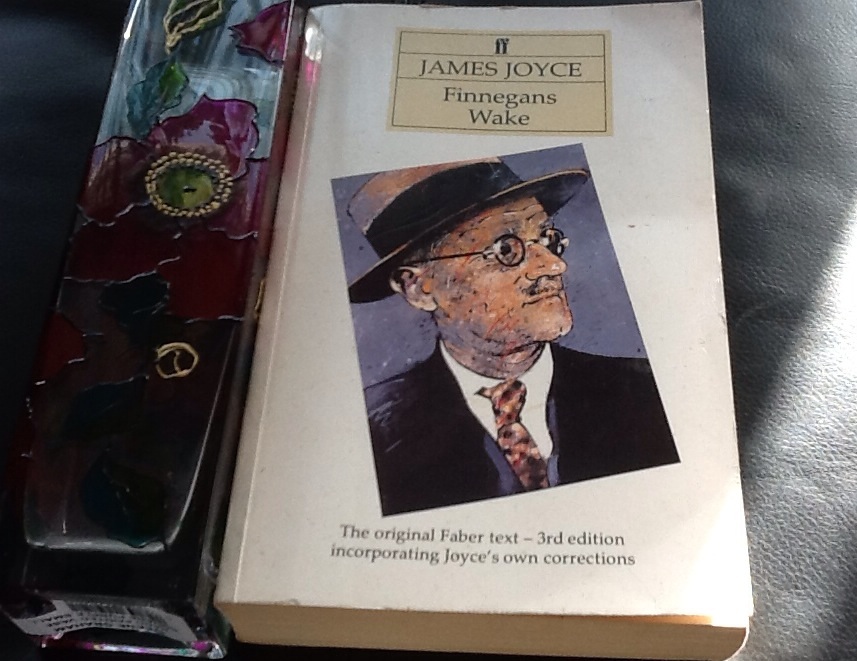
Rameau’s Nephew by Denis Diderot
Jacques the Fatalist by Denis Diderot
The Inmates by John Cowper Powys
The Magic Mountain by Thomas Mann
Finnegans Wake by James Joyce
The Villa Désirée and Other Uncanny Stories by May Sinclair
War With The Newts by Karel Capek
Facial Justice by LP Hartley
 PLUS links to my material upon:
A collection of my favourite passages from ‘The Glastonbury Romance’ by John Cowper Powys
My favourite passages from ‘Hidden Faces’: a novel by Salvador Dali
My website for Elizabeth Bowen, including my favourite passages from all her novel chapters and stories
The world’s first detailed review of all the published fiction works of Frances Oliver
Green Dolphin Country by Elizabeth Goudge – Links
The Book I Would Like To Be Buried With… Proust’s In Search of Lost Time

Wednesday, February 05, 2014
Finnegans Wake - James Joyce
FINNEGANS WAKE – James Joyce
First Published 1939 – This edition 1975

As I am awaiting for a few books to arrive, having pre-ordered them, I thought I would give James Joyce’s FINNEGANS WAKE a revisit, for gestalt real-time review purposes, which would represent a follow-up to similar such reviews in recent months, eg Rameau’s Nephew and Jacques the Fatalist by Denis Diderot, The Inmates by John Cowper Powys and The Magic Mountain by Thomas Mann. But FINNEGANS WAKE might be a challenge, too far! The passage below represents the first three paragraphs of this book, i.e. about two-thirds of a page, and there are 628 pages in total! But if I do continue with this public review it will appear in the comment stream below.—————————————————–
riverrun, past Eve and Adam’s, from swerve of shore to bend of bay, brings us by a commodius vicus of recirculation back to Howth Castle and Environs.
Sir Tristram, violer d’amores, fr’over the short sea, had passencore rearrived from North Armorica on this side the scraggy isthmus of Europe Minor to wielderfight his penisolate war: nor had topsawyer’s rocks by the stream Oconee exaggerated themselse to Laurens County’s gorgios while they went doublin their mumper all the time: nor avoice from afire bellowsed mishe mishe to tauftauf thuartpeatrick not yet, though venissoon after, had a kidscad buttended a bland old isaac: not yet, though all’s fair in vanessy, were sosie sesthers wroth with twone nathandjoe. Rot a peck of pa’s malt had Jhem or Shen brewed by arclight and rory end to the regginbrow was to be seen ringsome on the aquaface.
The fall (bababadalgharaghtakamminarronnkonnbronntonnerronntuonnthunntrovarrhounawnskawntoohoohoordenenthurnuk!) of a once wallstrait oldparr is retaled early in bed and later on life down through all christian minstrelsy. The great fall of the offwall entailed at such short notice the pftjschute of Finnegan, erse solid man, that the humptyhillhead of humself prumptly sends an unquiring one well to the west in quest of his tumptytumtoes: and their upturnpikepointandplace is at the knock out in the park where oranges have been laid to rust upon the green since devlinsfirst loved livvy.
Those who intend to follow this 'Finnegans Wake' real-time review over the next few weeks, months, years ... may also be interested in these links:
.
A collection of my favourite passages from 'The Glastonbury Romance' by John Cowper Powys .
My favourite passages from 'Hidden Faces': a novel by Salvador Dali .
My website for Elizabeth Bowen, including my favourite passages from all her novel chapters and stories .
My review of 'Valiant Razalia' by Michael Wyndham Thomas .
. TO BE CONTINUED HERE; http://dflewisreviews.wordpress.com/2014/02/05/finnegans-wake-james-joyce/
A collection of my favourite passages from 'The Glastonbury Romance' by John Cowper Powys .
My favourite passages from 'Hidden Faces': a novel by Salvador Dali .
My website for Elizabeth Bowen, including my favourite passages from all her novel chapters and stories .
My review of 'Valiant Razalia' by Michael Wyndham Thomas .
. TO BE CONTINUED HERE; http://dflewisreviews.wordpress.com/2014/02/05/finnegans-wake-james-joyce/
Monday, February 03, 2014
Infinite Fall
February 2, 2014 · 1:09 pm

I posted a blog entitled FOREVER AUTUMN HERE in September 2012, conveying some of my philosophy of life and literature. And this morning just after 5.30 a.m., the BBC Radio 4 weather forecaster stated that our Winter went missing and it was replaced by what he called “perpetual Autumn” – referring to the serial strong Autumn storms that have been besieging our UK islands for most of the Winter so far and into the foreseeable future.
For me, it seems apt to mention, in this context, Thomas Ligotti’s recent mass audience recognition written by Michael Calia in the Wall Street Journal (WSJ), a recognition for Ligotti’s bleak philosophy. Death Anxiety plays a part in this – and probably in some of the Scandinavian fiction bleaknesses they often show on UK TV on Saturday nights – but here the WSJ article concerned something entitled TRUE DETECTIVE of which I have no experience (nor do I have any experience of the Scandinavian TV fictions, for that matter!)
Regarding his Fiction art in particular, Ligotti already had in my view a well-deserved mass audience recognition a few years ago with the Virgin paperback of his fiction entitled TEATRO GROTTESCO, a book that I saw in all manner of public places, at least in the UK.
And I am intrigued by this new recognition for his philosophical standing. Although believing such recognition to be well-deserved by Ligotti in respect of philosophy as well as fiction, I wonder whether — with his perceived tenets of such philosophy within ‘the Contrivance of Horror’ entitled THE CONSPIRACY AGAINST THE HUMAN RACE (CATHR) — the above heightened profile of personal recognition could be seen to be either counter-productive or irrational for his type of bleak anti-natalist philosophy: a dilemma I first raised HERE in 2007 before CATHR was published. (Ligotti replied at that time as shown on that link.)
I remain to this day open-minded about it and would welcome further input from Ligotti and others. If further thoughts of mine should arise on this matter, I shall include them in the comment stream below.
Meanwhile, I suggest that any writers who propound bleakly philosophical anti-natalism and so forth deserve name recognition for their writing where such recognition is deliberately sought rather than ideally or logically subsumed by the nihilistic subject-matter. Financial reward for such writers (as a symbol of such recognition or simply as a human pragmatic need) may also be a deserved consolation to appease their Death Anxiety that often remains otherwise unconsoled by the sublimated or distractive creativity of hard work employed in writing about such matters. Perpetual Autumn indeed, never Winter’s Death. Infinite Fall.
For the record, THIS was my real-time review of CATHR soon after it was first published as a book.
Perpetual Autumn
I posted a blog entitled FOREVER AUTUMN HERE in September 2012, conveying some of my philosophy of life and literature. And this morning just after 5.30 a.m., the BBC Radio 4 weather forecaster stated that our Winter went missing and it was replaced by what he called “perpetual Autumn” – referring to the serial strong Autumn storms that have been besieging our UK islands for most of the Winter so far and into the foreseeable future.
For me, it seems apt to mention, in this context, Thomas Ligotti’s recent mass audience recognition written by Michael Calia in the Wall Street Journal (WSJ), a recognition for Ligotti’s bleak philosophy. Death Anxiety plays a part in this – and probably in some of the Scandinavian fiction bleaknesses they often show on UK TV on Saturday nights – but here the WSJ article concerned something entitled TRUE DETECTIVE of which I have no experience (nor do I have any experience of the Scandinavian TV fictions, for that matter!)
Regarding his Fiction art in particular, Ligotti already had in my view a well-deserved mass audience recognition a few years ago with the Virgin paperback of his fiction entitled TEATRO GROTTESCO, a book that I saw in all manner of public places, at least in the UK.
And I am intrigued by this new recognition for his philosophical standing. Although believing such recognition to be well-deserved by Ligotti in respect of philosophy as well as fiction, I wonder whether — with his perceived tenets of such philosophy within ‘the Contrivance of Horror’ entitled THE CONSPIRACY AGAINST THE HUMAN RACE (CATHR) — the above heightened profile of personal recognition could be seen to be either counter-productive or irrational for his type of bleak anti-natalist philosophy: a dilemma I first raised HERE in 2007 before CATHR was published. (Ligotti replied at that time as shown on that link.)
I remain to this day open-minded about it and would welcome further input from Ligotti and others. If further thoughts of mine should arise on this matter, I shall include them in the comment stream below.
Meanwhile, I suggest that any writers who propound bleakly philosophical anti-natalism and so forth deserve name recognition for their writing where such recognition is deliberately sought rather than ideally or logically subsumed by the nihilistic subject-matter. Financial reward for such writers (as a symbol of such recognition or simply as a human pragmatic need) may also be a deserved consolation to appease their Death Anxiety that often remains otherwise unconsoled by the sublimated or distractive creativity of hard work employed in writing about such matters. Perpetual Autumn indeed, never Winter’s Death. Infinite Fall.
For the record, THIS was my real-time review of CATHR soon after it was first published as a book.
- Just read a subsequent WSJ article (issued just now) about the TRUE DETECTIVE subject vis a vis Ligotti, Barron, Strantzas, Langan, Poe, Lovecraft etc.:- http://blogs.wsj.com/speakeasy/2014/02/02/writer-nic-pizzolatto-on-thomas-ligotti-and-the-weird-secrets-of-true-detective/
Yes, it’s great to have these public salutes to Weird fiction.
Meanwhile, though, my blog above is about CATHR and its ostensibly non-fiction nihilistic philosophy.
I understand that TRUE DETECTIVE is on-going and its hero still needs to fulfil his pure pessimism or anti-natalist credentials. As do most Weird Fiction writers other than Ligotti, I guess!
It seems to me that the writer of TRUE DETECTIVE, in this second WSJ article, is now retreating from CATHR as a stark anti-natalist philosophy on which his TRUE DETECTIVE hero bases his life, but rather approaching it as just another Weird or Horror fiction influence on him as if from a story by Poe or Lovecraft or by Ligotti himself rather than from a monumental philosophy of anti-natalism etc. like CATHR. - I now note the word ‘plagiarism’ is publicly being used in connection with above topic, i.e. it is being said that the words used by the hero of ‘True Detective’ have been taken direct from CATHR without the programme acknowledging that source?
I wonder how many in secular or religious monasteries or authorial ivory towers are ever sufficiently acknowledged? Or whether they can be or should be thus acknowledged – especially when one follows this dictum: it is futile to call life futile, because it is.

Monday, January 27, 2014
Wake Up, Phil
An excerpt from my review of INTERZONE #250 (TTA Press) here:

Wake Up, Phil by Georgina Bruce
“‘If only you knew,’ said Throom. ‘If only you knew how many chances you’ve had.’”
It seems unlikely that the author intended Throom to be a morph of Theramin, but it seems appropriate if she did so, especially in the context of the overall gestalt. The untouchable executive doctor in a corporation, a corporation that vies with another corporation, each seeking the slavish loyalties of its staff. This is on the face of it the clinching satire finale of Stufflebeam’s “I can’t escape my job” opening salvo. It is also a compelling and engaging absurdist narrative that sometimes approximates a painting by Picasso but is mainly a 1950s/1960s SF novel where townships work diligently at their own employments in the face of alien invasion or cerebral counter-clockworlds like Yoachim in reverse, and homely and housewifery things mixed in with the crazy fantasies or with a theramin music backing to various Forbidden Planets to where these wholesome nuclear families travelled to fraternise with robots or replicants or just playmates or puppy dogs,
There is a character in this last story – a writer called Phil – middle-aged and portly and wearing Hawaiian shirts. I hope this is not a spoiler but, for me, and perhaps for me alone, this is Philip K Dick. But there you go – the light bulb’s finally gone out. Good job I had two.
“Built-in obsolescence meant that Callihounds would die after seven years.”
Wake Up, Phil by Georgina Bruce
“‘If only you knew,’ said Throom. ‘If only you knew how many chances you’ve had.’”
It seems unlikely that the author intended Throom to be a morph of Theramin, but it seems appropriate if she did so, especially in the context of the overall gestalt. The untouchable executive doctor in a corporation, a corporation that vies with another corporation, each seeking the slavish loyalties of its staff. This is on the face of it the clinching satire finale of Stufflebeam’s “I can’t escape my job” opening salvo. It is also a compelling and engaging absurdist narrative that sometimes approximates a painting by Picasso but is mainly a 1950s/1960s SF novel where townships work diligently at their own employments in the face of alien invasion or cerebral counter-clockworlds like Yoachim in reverse, and homely and housewifery things mixed in with the crazy fantasies or with a theramin music backing to various Forbidden Planets to where these wholesome nuclear families travelled to fraternise with robots or replicants or just playmates or puppy dogs,
There is a character in this last story – a writer called Phil – middle-aged and portly and wearing Hawaiian shirts. I hope this is not a spoiler but, for me, and perhaps for me alone, this is Philip K Dick. But there you go – the light bulb’s finally gone out. Good job I had two.
“Built-in obsolescence meant that Callihounds would die after seven years.”
Friday, January 17, 2014
DANDY, MANDY, ANDY & ELENOR
Elenor knew she had three dolls
that she called Dandy, Mandy and Andy – because, well, she liked names like
that, rhyming, flowing like a river. If she had more dolls she would have called
them Handy, Shandy and Pandy – but then she remembered that Pandy was Andy’s
surname in that old kids’ programme from Fifties TV called ‘Watch With Mother’,
something Elenor was old enough to have experienced in real-time.
She was old enough, too,
to have dolls to play with again, though she refused to acknowledge she was now
entering her own second childhood. Picture Book on Mondays. Andy Pandy, Teddy
and Looby Loo on Tuesdays. Bill and Ben and Little Weed and the House That Did
or Didn’t Know All about It on Wednesdays. Rag, Tag and Bobtail on Thursdays.
The Woodentops on Fridays. Nothing on Saturdays or Sundays.
The rest of daytime hours had the Test Card or Welsh speaking programmes – and
Elenor lived in England...
Dandy suddenly sat up and
said: “Stop daydreaming about the past, Elenor.”
Elenor was startled. None
of the dolls had spoken before. Perhaps she was a doll herself, one that didn’t
rhyme or flow like a river. Dandy, Mandy, Andy and Elenor. Didn’t really go,
did it?
She felt tears pricking
at the corners of her eyes. Mandy was now stirring. These were things that were
happening that shouldn’t happen - a human being like Elenor being watched by
dolls to see if she still moved.
“Are you OK, Elenor?”
asked Mandy.
Andy had begun to crawl
on all fours towards Elenor.
“Can I do anything for
you, Elenor?” he asked. “You look as if you need a hand.”
Elenor strained her eyes
to look down at herself. She couldn’t have seen her hands because they were hidden
under a cushion as if they were ashamed of being hers. Her dress was down to
her ankles and, of course, she couldn’t have seen her face, being behind the
face itself – and the angle of the mirror over the fireplace couldn’t reflect
her at all, it seemed.
Then Looby Loo suddenly
came into the room. And all the dolls froze. They couldn’t be seen to be alive.
Maybe the house knew something about it. Its mirror, too. But that was that.
Looby Loo dragged Teddy across the carpet by his ear. And placed him next to Elenor. Except Looby
Loo never called her Elenor. She called her Bandy. And when Bandy was tilted in
a certain direction, her eyes opened wider to cry but it all spilled instead
from somewhere below the dress in whatever direction her legs went. A silent
Woodentop with a river of misplaced
tears.
Subscribe to:
Posts (Atom)
breaking hyphens and thus, as an example, line-breaking above becomes linebreaking. This may not be Joyce’s intention, but seems sensible as one cannot know for certain if any line-breaking hyphen is a real hyphen or indeed a line-breaking hyphen.
It seems to me that one needs to absorb this text as best as one is able, without worrying about what it is intended to mean. Then one can hope that gestation in the reading-mind will facilitate some sort of meaning gradually to emerge. In other words, taking not just a run but a riverun at the text’s panoply of assonance, graphology and implied syntax but without meticulously prowling or grubbing around in each known word and in each neologism for the desperate hope of uncovering connective entrails of meaningful semantics!
It’s like immersing oneself in Professor Stanley Unwin and Gerard Manley Hopkins and John Cowper Powys all crossed with a Joycean automatic writing of a very rarefied kind, yet one knows that there is a linear sense flow being injected somehow straight into the veins of your brain. From the Aristophanic “Brékkek Kékkek Kékkek Kékkek! Kóax Kóax Kóax!” to a passage that happens to contain the word ‘whorl’ that I used this morning on my main blog in a post entitled ‘Craquelure‘ without realising I would be encountering the same word here. ‘The Synchronised Shards of Random Truth and Fiction’ IN ACTION, I’d say!
“He’s stiff but he’s steady is Priam Olim! ’Twas he was the dacent gaylabouring youth. Sharpen his pillowscone, tap up his bier! E’erawhere in this whorl would ye hear sich a din again? With their deepbrow fundigs and the dusty fidelios. They laid him brawdawn alanglast bed. With a bockalips of finisky fore his feet. And a barrowload of guenesis hoer his head. Tee the tootal of the fluid hang the twoddle of the fuddled, O!”
“Jute. — Yutah!
Mutt. — Mukk’s pleasurad.
Jute. — Are you jeff?
Mutt. — Somehards.
Jute. — But you are not jeffmute?
Mutt. — Noho. Only an utterer.
Jute. — Whoa? Whoat is the mutter with you?
Mutt. — I became a stun a stummer.
Jute. — What a hauhauhauhaudibble thing, to be cause!”
[I have a friend called Jeff, and he has long had a set joke, whereby if anyone says to him: 'Are you deaf?' he always replies: 'No, I'm Jeff!']